For starters, industrial and manufacturing companies appear to be emerging from a long slump. Some companies took steps to streamline operations and cut costs so they would be better positioned to participate in broader growth. For example, within the transportation industry, railroad operator Union Pacific has disclosed plans to acquire rival Norfolk Southern Railway, creating a transcontinental line that would connect stops across the US and Canada. “This could help reduce transit times, boost competitiveness with trucking and lower costs for customers,” Ezzes says. Rival CSX similarly has taken steps to cut costs and boost efficiency.
Among industrials, soaring demand for air travel and rising defence budgets around the world have created strong tailwinds in the aerospace and defence industries. For example, GE Aerospace saw the order backlog for its jet engines rise to $190 billion at the start of the year. US defence contractor RTX, known for its sophisticated radar and missile defence systems, has seen orders climb as European and Middle Eastern nations seek to modernise their militaries. “I believe we are in the middle of a supercycle for aerospace,” Ezzes says.
Within the restaurant industry, consumers are still likely to go to restaurants to have humans serve them. Take coffee shop Starbucks, for example, which emphasises the customer experience. CEO Brian Nicole, who has a strong track record of turnarounds in the industry, has demonstrated a detailed knowledge of company operations.
The health care sector has come under pressure because of regulatory and pricing changes but it includes manufacturers of heavily regulated products that are hard to replicate. For example, Medtronic, a maker of surgical devices, operates more than 70 manufacturing plants globally. The company has taken steps to cut costs, including consolidating distribution centres and spinning off its diabetes division. “Their businesses have high barriers to entry, and with populations getting older, demand for medical procedures is likely to rise,” Ezzes adds.
2. Babies in the AI bathwater
Companies considered highly vulnerable to AI disruption, referred to earlier as AI roadkill, include a wide range of software, financial and consulting industries. After AI developer Anthropic said in February that its agentic AI tool Claude could automate a range of research and legal tasks, providers LegalZoom.com, Thomson Reuters and FactSet Research Systems suffered steep declines.
“The market appears to have concluded that many software as a service (SaaS) companies will go into perpetual decline as a result of AI-enabled competition,” says Mark Casey, an equity portfolio manager. “Probably some of them will, but others seem well insulated from AI risks, and still others seem set to benefit from AI. I am looking closely at many of these companies in search of the proverbial babies that have been thrown out with the bathwater.”
For example, Salesforce, a customer relationship management platform, has been a focal point of disruption fears and its share price has declined sharply this year over concerns that AI tools make it easier for customers and competitors to replicate its functionality. At the same time, the company is taking aggressive steps to integrate AI features into its offerings. The company’s status as a system of record and deep integration with key business workflows may provide it with sufficient advantages to fend off AI-powered competition.
IT consulting businesses such as Gartner and Accenture, which offer research and advice to businesses about technology decisions, have also come under fire.
“Both companies have launched initiatives to help clients identify use cases for generative AI, adopt AI tools and integrate them into organisations. What’s more , the complexity of IT decision-making is not getting simpler in the age of AI,” Casey notes.
3. AI picks and shovels
You cannot build a new economy without old economy companies. It is well known that the AI buildout relies heavily on makers of power generation and cooling equipment, utilities and mining companies. These are the proverbial picks and shovels supplying AI infrastructure.
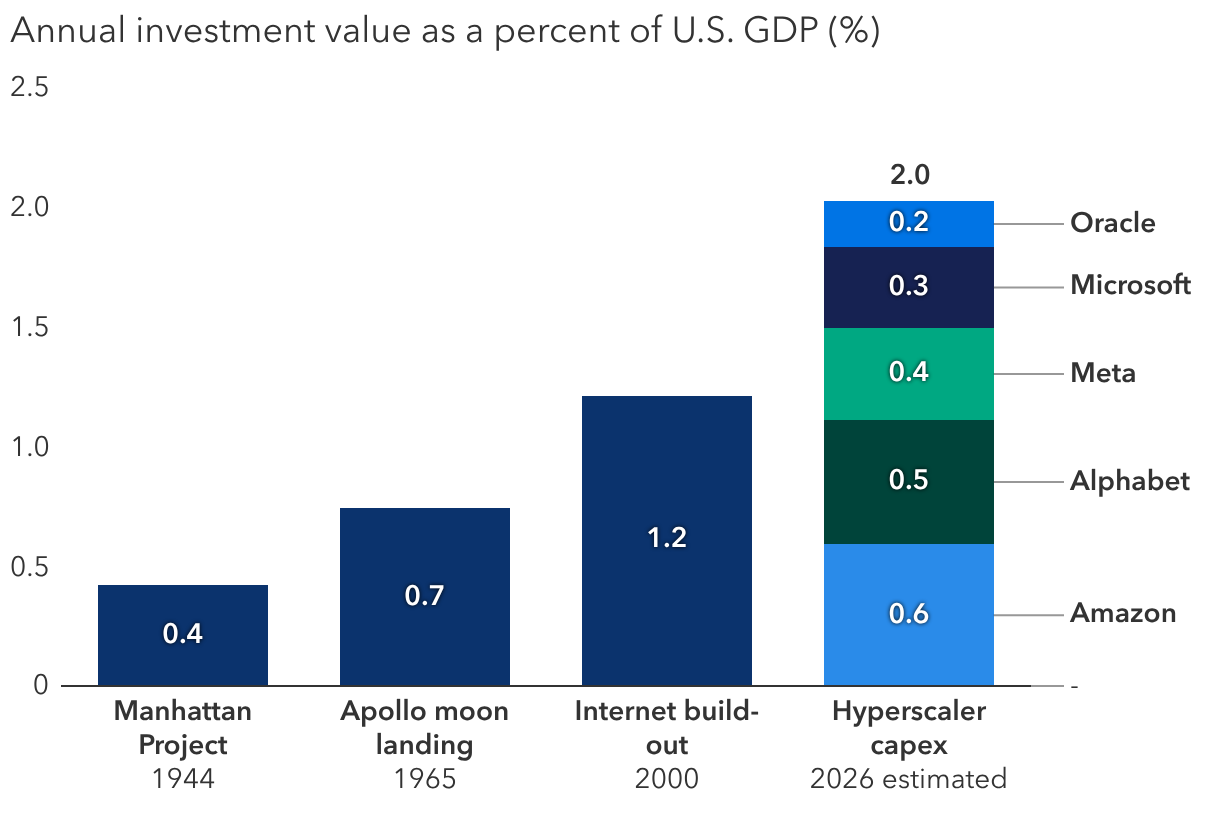
The hyperscaler companies driving the AI revolution have committed to investing $650 billion in capital expenditures, primarily to build out AI data centres. “To put this in context, it is more than 2.5 times the amount spent in 2025,” notes Ezzes. The historic spending could account for an estimated 2% of GDP, far larger than other major capital projects in history, including the Manhattan Project and the Apollo space mission in 1965. Those projects led to innovations that reshaped industries for decades and led to the creation of new companies.