Retirement How to harness the power of compounding

KEY TAKEAWAYS

  • The power of compounding comes from earning returns not only on your original investment, but also on previously accumulated returns.
  • Time can be a powerful ally, giving investments more opportunity to compound.
  • Starting with a modest amount and investing consistently can potentially be more impactful than waiting until you have a large sum to invest.

If you're given a choice today between:


  • $1 million in cash today, or
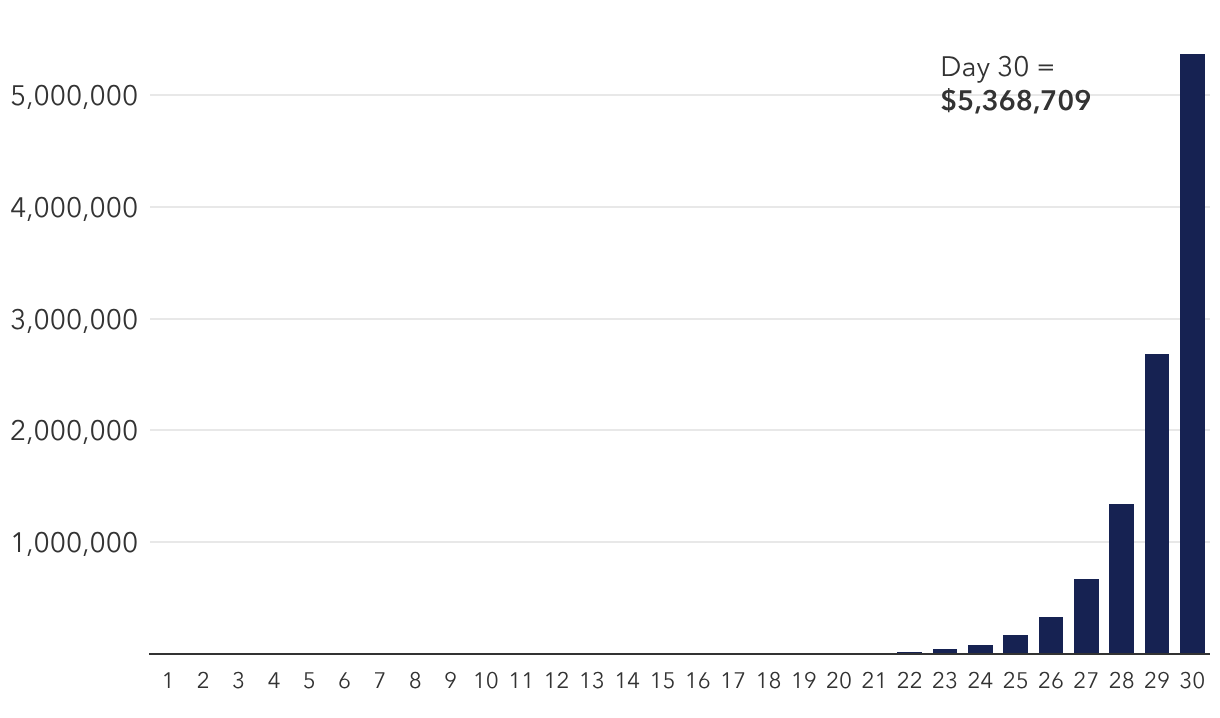
  • $0.01 that doubles in value every day for 30 days


It might seem intuitive to take the first option. After all, what could a mere cent become? In 15 days, the amount is only $163. In fact, after 20 days, you're still at $5,242, a far cry from the competing offer.

The power of compounding is often least visible at the beginning

Hypothetical example for illustrative purposes only.

But as each day's growth builds on the previous day's growth, the final few days change the outcome dramatically. At day 28, you’d have accumulated $1.34 million, and at day 30, it would be worth more than $5.3 million. This is the power of compounding.


How the power of compounding works

Returns on returns


This is an extreme mathematical example rather than a realistic investment outcome. However, it illustrates an important point: compounding may appear slow at first because the early returns are being generated on a relatively small amount. As the amount grows, each new return has a larger base on which to build.


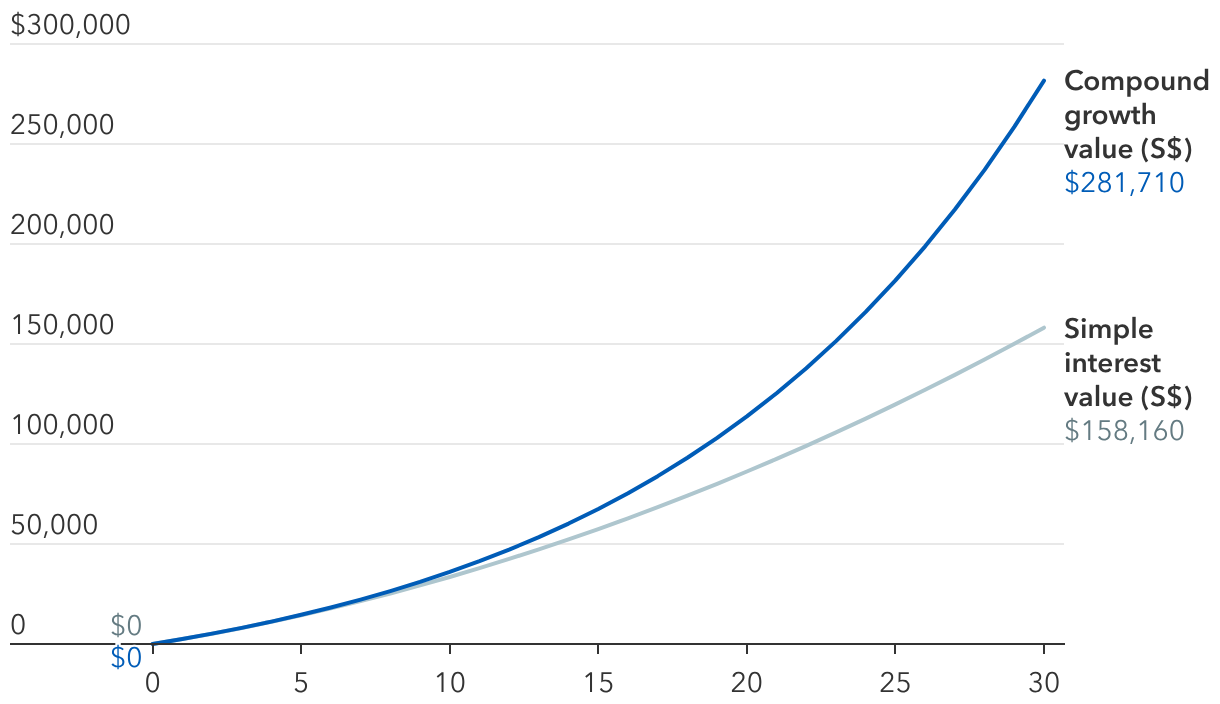
With simple interest, interest is calculated only on the original amount. With compound interest, interest is calculated on both the original amount and the interest previously earned.

For example, if $10,000 earned a simple interest of 8% a year, it would generate S$800 every year. After 20 years, the total value would be S$26,000. If the same S$10,000 compounded at a hypothetical 8% annual rate, with no fees or withdrawals, it would grow to approximately S$46,610 after 20 years. The difference arises because the returns remain invested and have the opportunity to generate further returns.

Hypothetical example for illustrative purposes only.


Rule of 72


The Rule of 72 is a simple way to estimate how long it may take for money to double at a given annual rate of return. Simply divide 72 by your expected annual return.

Using the Rule of 72:

  • At 6% a year, your money could double in about 12 years
  • At 8% a year, it could double in about 9 years
  • At 10% a year, it could double in about 7 years

The power of time


Compounding needs time to work because investment growth is not only generated on new contributions, but also returns accumulated in previous years.


When it comes to retirement planning in Singapore, starting early and staying consistent matters more than how much you invest. The sooner you start, the longer your investments have to grow and generate returns on those returns.


How to harness the power of compounding?


Start with an amount you can realistically sustain


One common mistake is assuming you need a large amount of money before you can start investing. While it is important to first build an adequate emergency fund and ensure your short-term financial needs are covered, many investors find that waiting until they have "enough" money can delay getting started indefinitely.


For example, if you're planning to buy a home in the next few years or managing family expenses, investing $1,000 a month may not be realistic. However, starting with a modest, sustainable amount can still help you begin benefiting from the power of compounding.

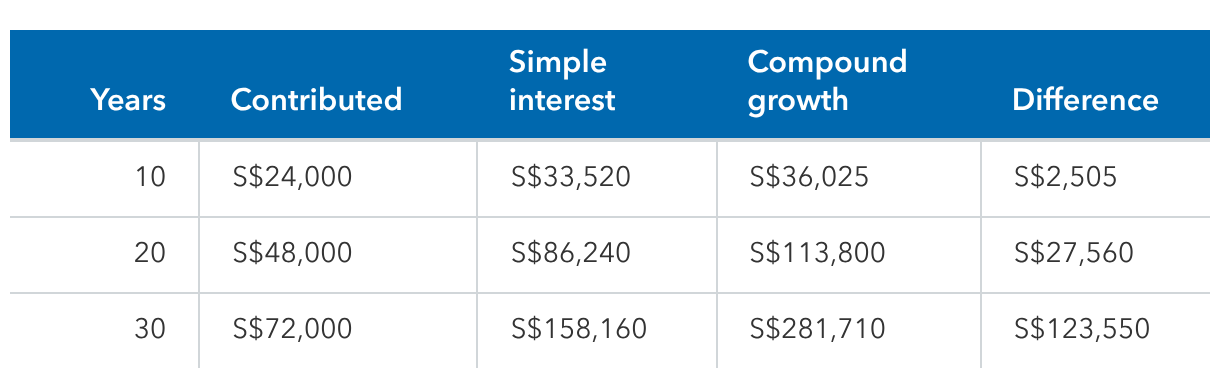
Small, consistent investments can grow meaningfully over time

For illustrative purposes only. Based on monthly contributions of S$200 and a hypothetical annual return of 8%. Actual returns will vary and may be negative. Figures exclude fees, taxes and inflation.

Sarah started working at age 25 and decided to set aside S$200 a month for her retirement. Instead of leaving the money in cash, she invests in a diversified portfolio of global equities. Over time, Sarah's money has the potential to achieve outsized growth compared to if she did not invest, as any gains remain invested and generate gains of their own. This example assumes her investments grow at 8% a year, in line with the annualised return delivered by global equities over the past 38 years1.


The goal is not to maximise your investment contributions immediately, but to strike a balance between meeting your near-term financial needs and putting your money to work for the future by starting small.


Automate monthly contributions


Markets will inevitably experience periods of volatility. Automating contributions can help remove some of the emotion and guesswork from investing by encouraging consistency regardless of market conditions. For long-term investors, success is often driven less by perfect timing and more by maintaining a disciplined investment approach through different market environments.


Increase contributions when circumstances allow


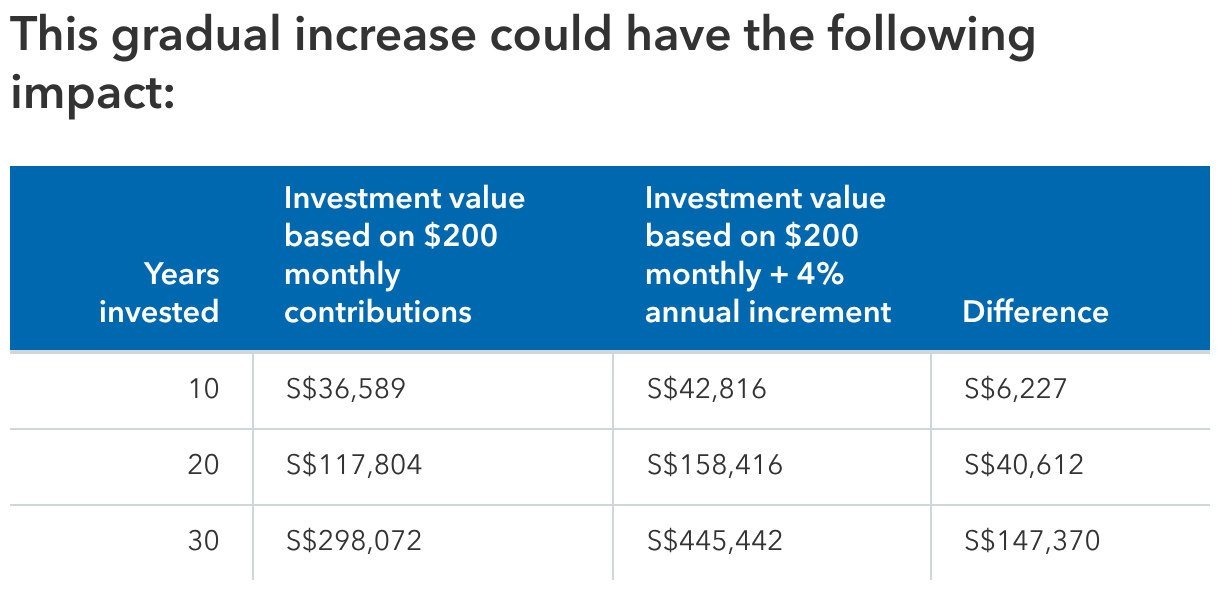
Your first investment contribution does not need to be your final one. As your income grows, debts are paid down or major expenses are completed, you could consider gradually increasing the amount you invest.


For example, an investor could begin with S$200 a month and increase that amount by 4% each year. After 30 years, the stepped-up approach produces an illustrative portfolio value around 49% higher than keeping the contribution fixed at S$200 a month.

For illustrative purposes only. Hypothetical example assumes an 8% annual return, monthly contributions of $200, annual contribution increases of 4% where stated, and reinvestment of returns. Actual results may vary and are not guaranteed.

Small steps can make a big difference


Many investors assume they need to achieve certain financial milestones before they can start investing, whether that's buying a home or increasing their income substantially. While these goals are important, the power of compounding highlights the potential value of getting started early. Even small amounts invested today can have years to grow and generate returns on those returns.

Frequently asked questions

Compound interest refers to earning returns on both your original investment and previously accumulated returns.

Compounding allows investment growth to build on itself over time. The longer money remains invested, the greater the opportunity for returns to generate additional returns.

Compounding can benefit both large and small investments. Consistency and time invested are often important factors in determining long-term outcomes.

There is no single answer that applies to everyone, but the power of compounding means that starting earlier generally gives investments more time to grow.

1. As from 31 December 1987 to 31 December 2025. Sources: MSCI, RIMES.

This communication is of a general nature, and not intended to provide investment, tax or other advice, or to be a solicitation or recommendation to buy or sell any securities.


The value of investments and income from them can go down as well as up and you may lose some or all of your initial investment.


All information is as at the date indicated and attributed to Capital Group unless otherwise stated. While Capital Group uses reasonable efforts to obtain information from third-party sources that it believes to be accurate, this cannot be guaranteed.


In Singapore, this communication has been prepared by Capital Group Investment Management Pte. Ltd. (CGIMPL), a member of Capital Group, a company incorporated in Singapore. This advertisement or publication has not been reviewed by the Monetary Authority of Singapore. Neither has it been reviewed by any other regulator.


All Capital Group trademarks are owned by The Capital Group Companies, Inc. or an affiliated company. All other company names mentioned are the property of their respective companies.


© 2026 Capital Group. All rights reserved.