Retirement How to beat inflation and futureproof your savings

KEY TAKEAWAYS

  • Let time do the heavy lifting: starting early gives investment returns more time to compound.
  • Do not rely on one inflation hedge: diversify across assets, sectors and markets.
  • Allow your portfolio to evolve: review your investment mix as your life situation changes.

A cup of kopi that cost 40 cents in the 90s now costs at least S$1.50 today, nearly four times as much. Inflation, the rise in prices of goods and services over time, affects nearly every part of daily life in Singapore. We see it in our grocery bills, utility costs, transport fares, and health care.


The impact also varies by category. In 2025, Singapore's overall Consumer Price Index rose 0.9%, while the Healthcare Consumer Price Index rose 2.7%. For retirement planning, this matters because the costs you rely on later in life may rise faster than headline inflation. Over time, even moderate inflation compounds. If your money does not grow as quickly as prices, purchasing power erodes.


At a steady 2% inflation rate, $50,000 in 30 years will feel more like $27,604 in today’s money.
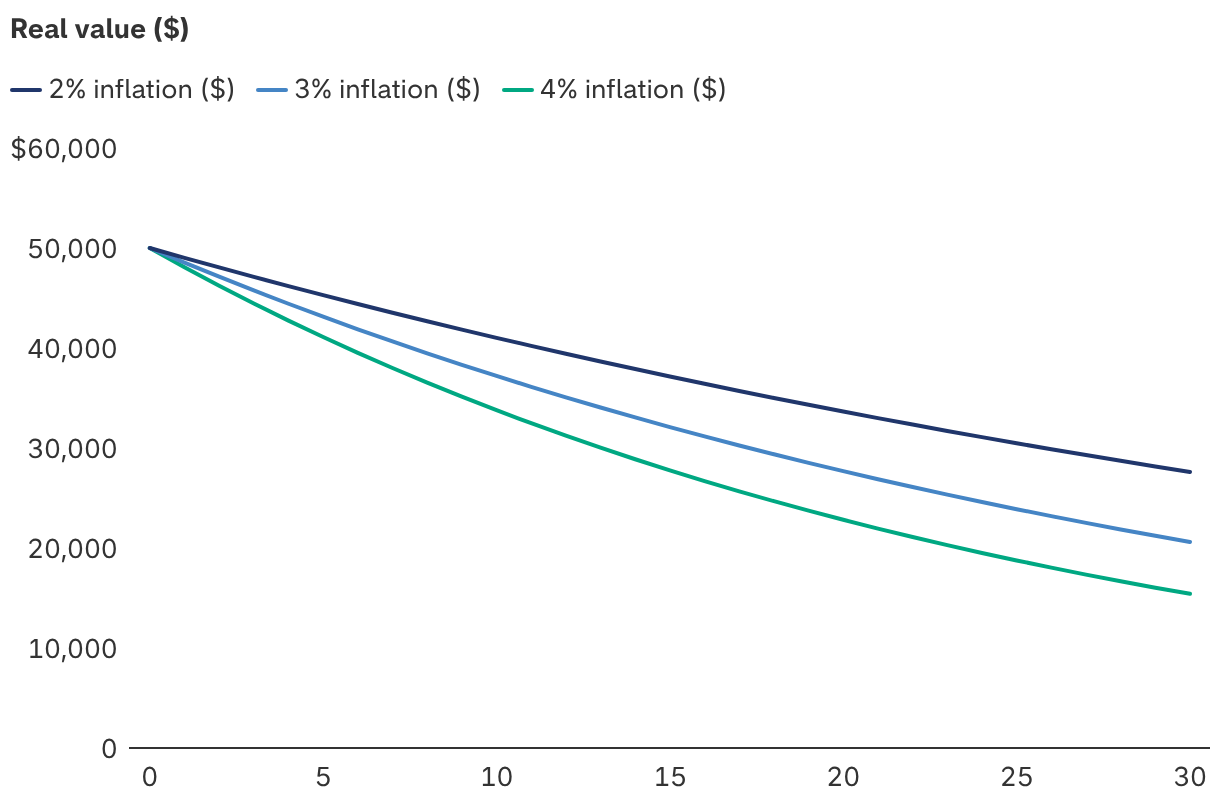
Real value of $50,000 over time

How to stay ahead of inflation

When prices rise, the first instinct is usually to cut back. Skip the bubble tea, hold off on holidays, cook more, and eat out less. This helps, but there’s a limit to how much you can trim. Beating inflation requires more than spending less. For long-term goals such as retirement, you need to give your money the opportunity to grow faster than prices.


That does not mean reacting to every rise in inflation or changing your portfolio based on what performed well recently. Short-term moves can pull a retirement plan away from its long-term purpose. A more durable approach is to start early, invest consistently, stay diversified, and review your plan as your life situation changes.


Let time do the heavy lifting


Time can be one of your most powerful tools against inflation. The earlier you begin investing for retirement, the longer returns have to generate returns of their own.

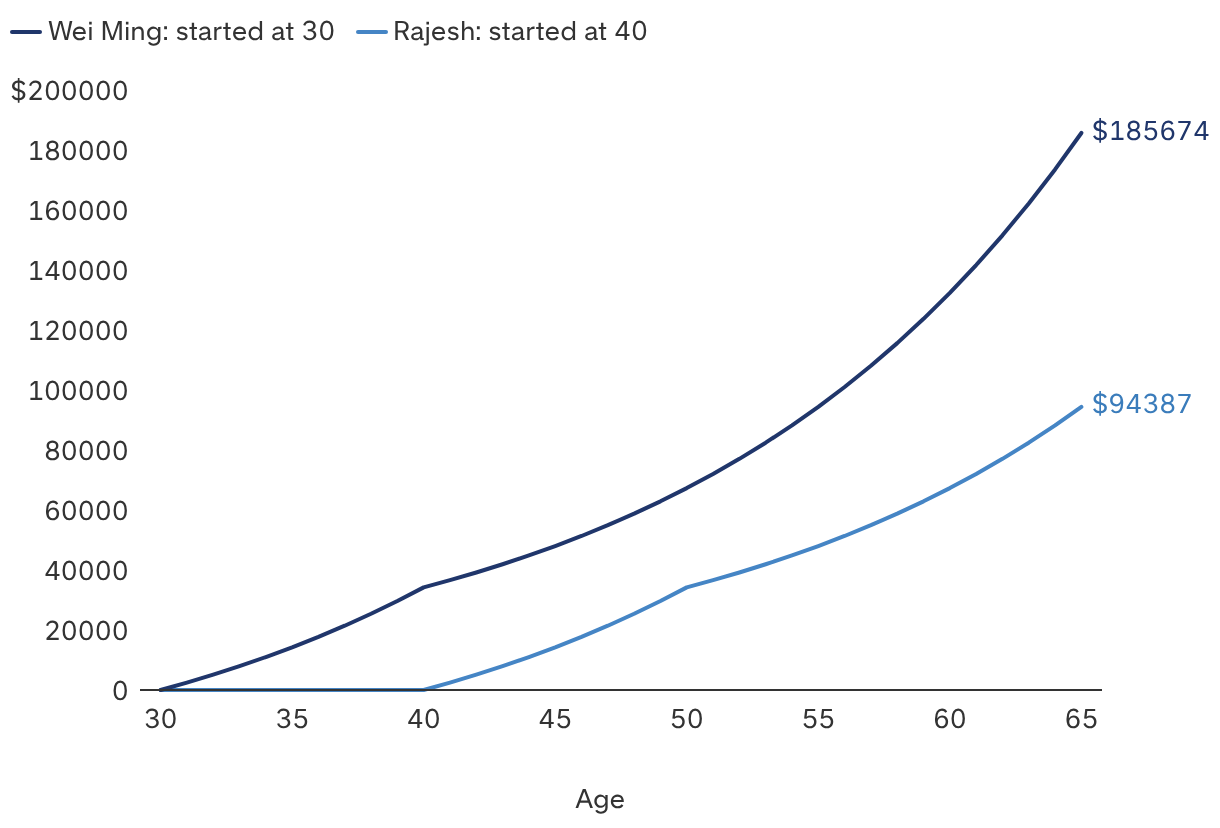
Same monthly amount, two different outcomes

For illustrative purposes only. Assumes a hypothetical annual rate of return of 7%, compounded monthly. Actual investment results will vary and may be higher or lower than those shown. Fees, taxes and inflation have not been considered.

Consider Wei Ming and Rajesh. Both invested in the same fund and contributed the same amount each month. The only thing that changed was when they got started. By age 65, Wei Ming's investment returns were more than double of Rajesh's. The difference wasn't skill, but time.

Singapore's inflation rate has averaged around 2.6% a year since the 1960s. As a broad benchmark, money earning less than that would lose purchasing power over time. This is what losing value in real terms means: while the dollar amount has increased, it is worth less after accounting for inflation.

If your retirement goal is still decades away, a longer time horizon may allow you to take more risks as you have more time to recover from periods of market volatility. Stocks can provide long-term growth potential, while bonds can add income and help to preserve capital. The appropriate balance depends on your goals and comfort with risk.


Cash still plays an essential role. An emergency fund of around six to 12 months of expenses can help cover unexpected expenses, while money intended for short-term goals in the next 3 to 5 years may be best held in cash or lower-risk options. Once you've identified which money needs to stay in cash and which money can be invested for the long term, the next step is deciding how to invest it.

Consider this: Review your finances, decide how much you can invest regularly, and put the power of compounding to work as early as possible.

1. Don’t put all your eggs in one basket


It can be tempting to look for the one investment that will always beat inflation. In reality, different inflationary periods have rewarded different assets, which makes betting on any single one a losing game over the long run.


Gold and other commodities, for example, can perform well when prices rise sharply, but have tended to lag in the long term.


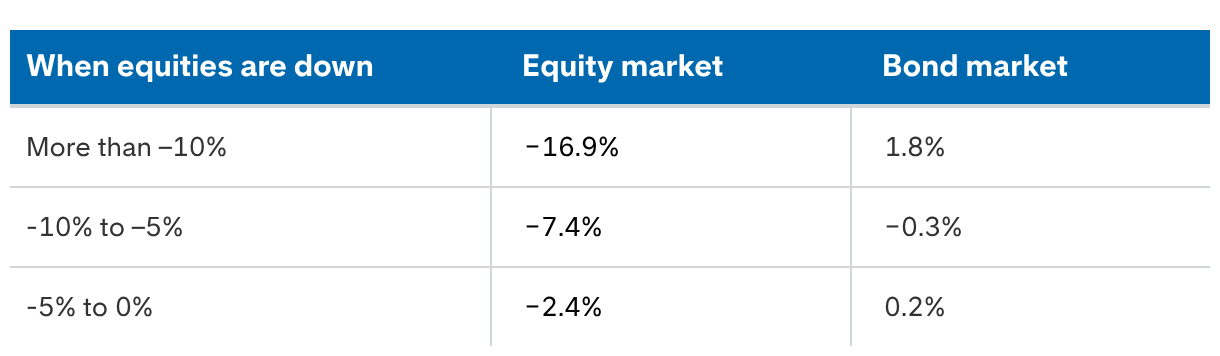
Rather than trying to predict the next winner, consider building a diversified portfolio across asset classes, sectors, and regions. When one area struggles, another may help to cushion the impact. For example, bonds have historically helped to soften the impact of equity market declines.

Average returns during equity market downturns

As at 28 February 2026. Figures reflect monthly data using rolling three-month total returns between February 2006 and February 2026. Total number of decline periods is 63, or 26% of all monthly periods as the sample. Equity market represented by S&P 500 Index. Bond market represented by Bloomberg US Aggregate Index.

Sources: Capital Group, Bloomberg.

Within stocks and bonds, investors can also diversify across sectors and regions to reduce exposure to a single risk or economic outcome. While diversification may not eliminate losses, it can help smooth the investment journey and make it easier to stay invested through changing market conditions.

Consider this: Instead of attempting to predict the next winner, build a diversified portfolio that can weather different market conditions.

2. Review and adjust your portfolio as retirement approaches


Inflation risk is felt differently at different life stages. For those near or in retirement and relying on savings, the pain of sharply rising prices can feel more acute.


The portfolio that suits you today may not be the one you need tomorrow. Consider reviewing your retirement plan once a year, or whenever there is a major life event such as getting married, buying a home, and career change.


Reassess whether your retirement goals, time horizon and risk appetite remain aligned with your portfolio. As retirement approaches, this may mean gradually adjusting your investment mix rather than making sudden changes later on.

For those who prefer a more hands-off approach, target date funds are designed to automatically adjust your asset allocation over time, typically becoming more conservative as your target retirement date approaches.

Consider this: Review your portfolio against your goals, time horizon, and risk appetite once a year, and adjust it as your needs change.

A simpler way to think about how to beat inflation in Singapore


Prices will continue to rise, but what is in your control is deciding where your money sits in the meantime. Keep enough cash for emergencies and anything you'll need in the six to twelve months. For your retirement pot, that money needs room to grow faster than prices do. Start with what you can set aside each month, spread it across different investments rather than betting on one, and revisit the plan as your life situation changes.

Frequently asked questions

Inflation refers to the steady rise in the price of goods and services over time. Singapore measures it two ways: through the Consumer Price Index, which tracks headline inflation, and through MAS Core Inflation, which strips out private transport and accommodation costs to show the more lasting price pressure underneath.

Singapore's headline inflation rate was 2.3% year on year in August 2026, and MAS Core Inflation was 2.2%. As at August 2026, MAS forecasts both to average between 1.5% and 2.5% for the whole of 2026, with core inflation staying elevated into early 2027.

Inflation is the gradual rise in the prices of goods and services over time. It can be driven by strong consumer demand, supply disruptions, growth in money supply or changing inflation expectations. Several of these forces can occur simultaneously.

CPF's interest rates are 2.5% on the Ordinary Account and 4% on the Special, MediSave and Retirement Accounts as at the last quarter of 2026. These figures have generally stayed ahead of Singapore's inflation rate in recent years, making CPF a reasonably strong foundation. It's not guaranteed to outpace inflation in every environment, which is one reason many people consider investing their CPF savings.

All figures in SGD terms.

Inflation data as at October 2026. Sources: Singapore Department of Statistics (SingStat), Monetary Authority of Singapore (MAS), Ministry of Health.

This communication is of a general nature, and not intended to provide investment, tax or other advice, or to be a solicitation or recommendation to buy or sell any securities.


The value of investments and income from them can go down as well as up and you may lose some or all of your initial investment.


All information is as at the date indicated and attributed to Capital Group unless otherwise stated. While Capital Group uses reasonable efforts to obtain information from third-party sources that it believes to be accurate, this cannot be guaranteed.


In Singapore, this communication has been prepared by Capital Group Investment Management Pte. Ltd. (CGIMPL), a member of Capital Group, a company incorporated in Singapore. This advertisement or publication has not been reviewed by the Monetary Authority of Singapore. Neither has it been reviewed by any other regulator.


All Capital Group trademarks are owned by The Capital Group Companies, Inc. or an affiliated company. All other company names mentioned are the property of their respective companies.


© 2026 Capital Group. All rights reserved.