Retirement What to do when the stock market goes down

KEY TAKEAWAYS

  • Market downturns are a part of long-term investing.
  • The biggest investment risk during volatile periods is often reacting emotionally rather than sticking to a long-term plan.
  • Before making changes to your portfolio, it can help to revisit the goal you're investing for in the first place.

One of the most difficult aspects of investing isn't deciding how to invest when markets are rising.


It's deciding what to do when markets fall.


When market volatility increases, investors are often faced with a steady stream of unsettling headlines, conflicting opinions and uncertainty about what comes next.

In moments like these, it's natural to wonder:


  • Should I sell?
  • Should I wait for markets to recover?
  • Should I stop investing for now?
  • What if this time is different?

These are questions many investors ask during periods of market uncertainty.


The challenge is that decisions made during periods of uncertainty can often have a greater impact on long-term outcomes than the downturn itself.

When in doubt, zoom out


Looking back, market downturns often appear temporary. Living through them can feel very different.


Negative headlines dominate the news. Predictions become increasingly pessimistic. It can feel like you need to do something.


Yet investors have been through periods of uncertainty before, including financial crises, recessions, geopolitical conflicts and pandemics. Markets have continued to experience both downturns and recoveries throughout that time.

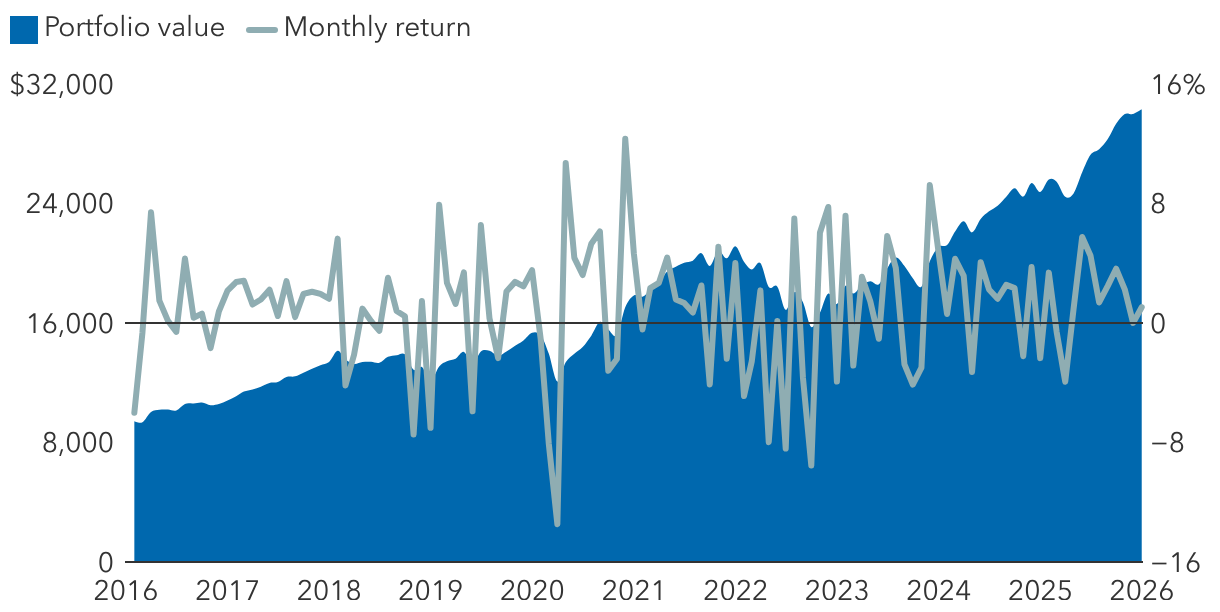
Two views of the same investment tell a very different story

Change in value of initial US$10k investment in global equities

Past results are not a guarantee of future results. Hypothetical example shown for illustrative purposes only. Investors cannot invest directly in an index.


Global equities represented by MSCI All Country World Index with net returns. Figures reflect total returns in USD, as of 31 December 2025. Left hand side: Portfolio value of an initial US$10k investment from 1 January 2015 to 31 December 2025. Right hand side: Monthly returns. Sources: Capital Group, MSCI, RIMES. 

Short-term view
 
Monthly market returns can feel unpredictable and unsettling. 
Long-term view
 
A hypothetical US$10,000 investment held for the 10 years ended 2024 would have grown to more than US$30,000 despite periods of significant volatility, including the COVID-19 market selloff. 

Key point:


The same investment can tell two very different stories, depending on how far back you step.

Looking at markets through a longer lens doesn't remove uncertainty, but it can help put today's market volatility into perspective.

Before making any changes
 
When markets fall, it can be helpful to pause and ask:
  • Has my retirement goal changed?
  • Has my investment timeline changed?
  • Has my financial situation changed significantly?
  • Or am I reacting to recent market movements?

Sometimes a change may genuinely be needed.


But often, the market has changed more than the long-term goal has.

Has anything really changed?


A market downturn can change a lot of things. The value of your portfolio may be lower than it was a few months ago. The headlines may be more pessimistic. You may even feel less confident about decisions that felt perfectly reasonable when markets were rising.


Before making any major changes, it may be worth taking a step back and asking a different question: has anything actually changed about the reason you're investing?


For some investors, the answer may be yes. A change in financial circumstances, retirement plans or investment timeline may warrant a review of their strategy.


For many others, though, the market may have changed more than the goal itself.


Sometimes, after reviewing your goals and circumstances, you'll decide that action is needed. At other times, the best thing to do may be nothing at all.


Because successful retirement investing isn't about reacting to every market movement. It's about staying focused on the retirement you're working towards, even when markets become uncomfortable.

This communication is of a general nature, and not intended to provide investment, tax or other advice, or to be a solicitation or recommendation to buy or sell any securities.


The value of investments and income from them can go down as well as up and you may lose some or all of your initial investment.


All information is as at the date indicated and attributed to Capital Group unless otherwise stated. While Capital Group uses reasonable efforts to obtain information from third-party sources that it believes to be accurate, this cannot be guaranteed.


In Singapore, this communication has been prepared by Capital Group Investment Management Pte. Ltd. (CGIMPL), a member of Capital Group, a company incorporated in Singapore. This advertisement or publication has not been reviewed by the Monetary Authority of Singapore. Neither has it been reviewed by any other regulator.


All Capital Group trademarks are owned by The Capital Group Companies, Inc. or an affiliated company. All other company names mentioned are the property of their respective companies.


© 2026 Capital Group. All rights reserved.