
.png)
The Multi-Sector Income Fund combines the power of four key fixed income credit sectors, each of which has distinctive income characteristics.
Opportunities
OPPORTUNITIES
Income in the new investment regime
While interest rates have languished at near-zero for many years, they are back with a vengeance. It is now possible to derive a meaningful level of income from a globally diversified portfolio of bonds.
- Bond yields: Could history be repeating itself?
- Income generation strategies
.png)
Past results are not a guarantee of future results.
As at 31 December 2024. Source: Bloomberg. US 10 year: US Government 10-year index
THE POWER OF 4
Capital Group Multi-Sector Income Fund (LUX)
A fund that combines the four fixed income sectors in a single portfolio offers the potential to benefit from attractive income with less volatility.
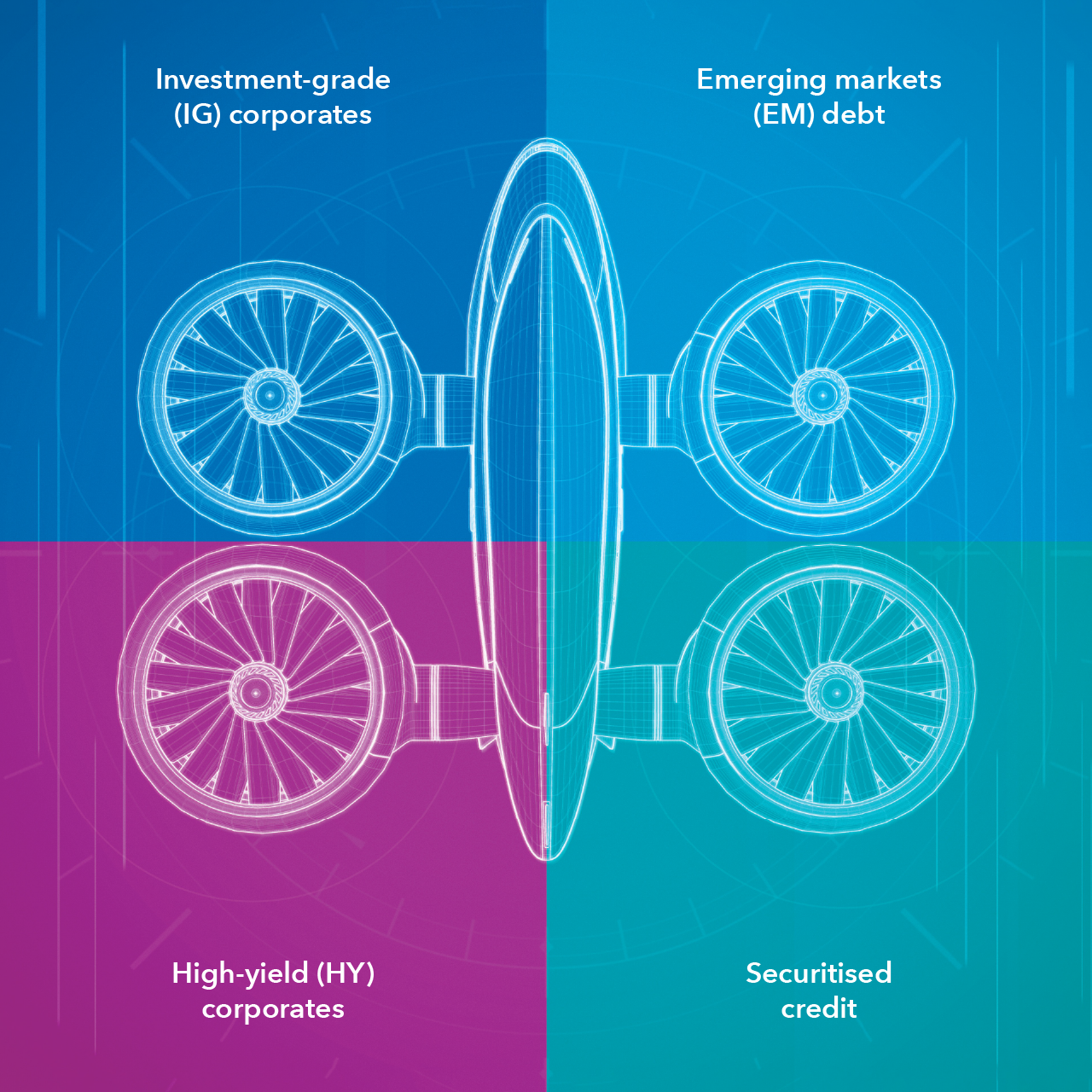
Investment-grade corporate bonds
Bonds issued by companies to finance their spending or investment. Considered higher quality, typically meaning they carry a lower risk of default but consequently tend to pay a lower income. The main focus is on US bonds.
Emerging market bonds
Bonds issued by governments or companies in developing countries, which typically offer higher growth prospects but carry greater risks given their stage of development. Here we primarily focus on government bonds issued in US dollars.
High-yield corporate bonds
Bonds issued by companies to finance their spending or investment. Considered generally lower quality, typically meaning they carry a higher risk of default but consequently tend to pay a higher income. The main focus is on US bonds.
Securitised bonds
Financial securities that are created by securitising individual loans. These can range from residential or commercial mortgages, to auto loans or other asset-backed securities.
The fund may also invest a small proportion of the portfolio outside these sectors as an opportunistic exposure.
The fund seeks an optimal balance between high-quality and high-yielding assets. High-quality bonds offer stability and resilience, while bonds with higher income potential can enhance cash flows and yield. A well-balanced mix of these assets can deliver a robust level of income while aiming to keep risks in check.
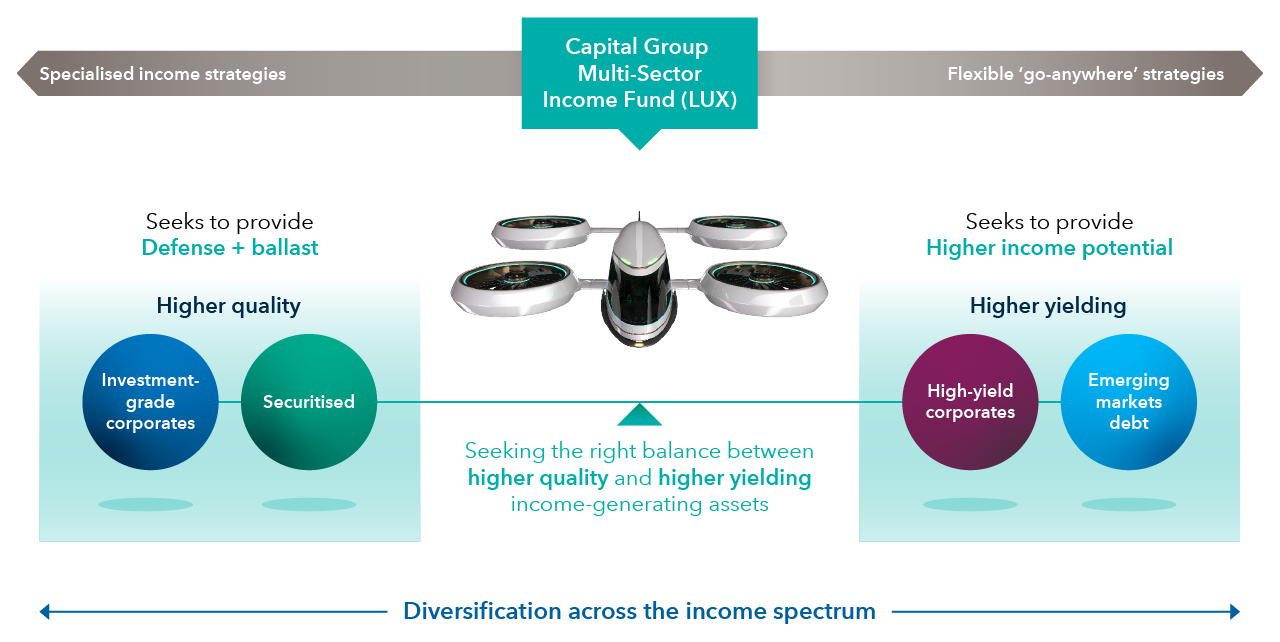
Our portfolio managers have the flexibility to dynamically change, or ‘tilt’, the portfolio across the four sectors to reflect our latest investment views. This flexibility helps managers to take advantage of opportunities and mitigate risks where possible.
Diversification across income sectors
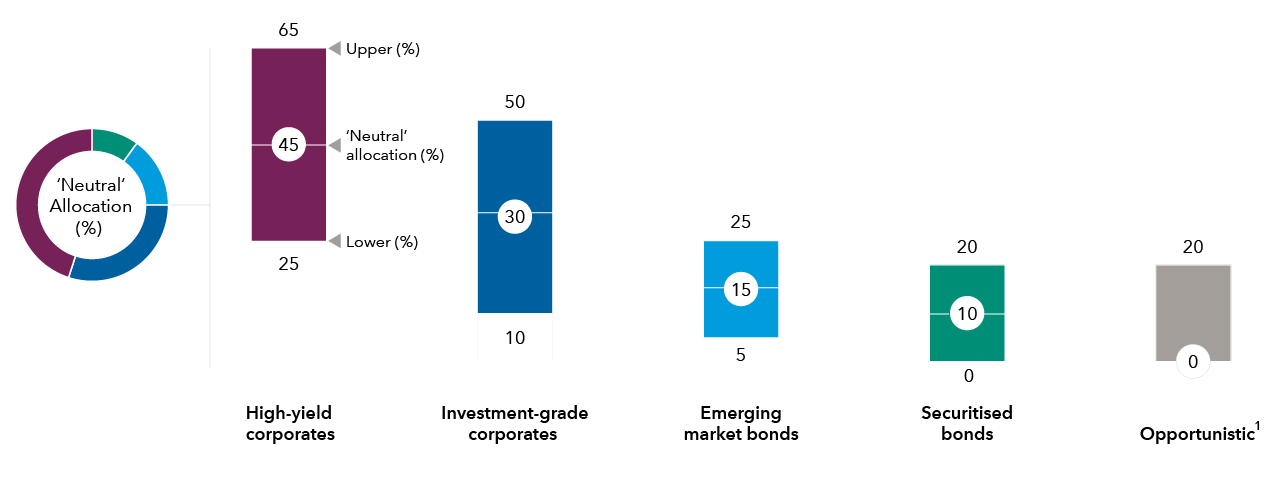
The allocations (%) illustrated indicate the typical range within which a sector will be represented. ‘Neutral allocation’ reflects the allocation under normal market conditions.
1. The managers have the option to invest in other areas in an opportunistic way if they identify particularly attractive opportunities, but this typically remains a small part of the overall allocation. This may include, but is not limited to, US government debt, municipal debt and non-corporate credit, in response to market conditions.
EXPERIENCE COUNTS
Managed by an experienced and specialist team
Each of the four sectors is managed by an experienced sector specialist portfolio manager. They are supported by large, dedicated investment analyst teams that help create a portfolio built on deep insights into each of the securities the fund invests in.

Damien McCann
Fixed Income Portfolio Manager
Los Angeles
Years of Capital Group Experience: 26

Shannon Ward
Fixed Income Portfolio Manager
Los Angeles
Years of Capital Group Experience: 9

Sandro Lazzarini
Portfolio Manager
Los Angeles
Years of Capital Group Experience: 11

Scott Sykes
Portfolio Manager
New York
Years of Capital Group Experience: 20

Robert Burgess
Fixed Income Portfolio Manager
London
Years of Capital Group Experience: 10

Xavier Goss
Portfolio Manager
Los Angeles
Years of Capital Group Experience: 5
Years of experience as at 31 December 2025.
WHY CAPITAL GROUP
A leader in global investing
For more than 90 years, we’ve been searching the world for long-term opportunities, making Capital one of the oldest global investors today.
Global investing credentials
*Assets under management by Capital Fixed Income Investors. Data as at 31 December 2024
Capital Group Multi-Sector Income Fund (LUX)
Risk factors you should consider before investing:
- This material is not intended to provide investment advice or be considered a personal recommendation.
- The value of investments and income from them can go down as well as up and you may lose some or all of your initial investment.
- Past results are not a guarantee of future results.
- If the currency in which you invest strengthens against the currency in which the underlying investments of the fund are made, the value of your investment will decrease. Currency hedging seeks to limit this, but there is no guarantee that hedging will be totally successful.
- Some portfolios may invest in financial derivative instruments for investment purposes, hedging and/or efficient portfolio management.
- The Prospectus - together with locally required offering documentation - sets out risks which, depending on the fund, may include risks associated with investing in fixed income, derivatives, emerging markets and/or high-yield securities; emerging markets are volatile and may suffer from liquidity problems.
All data as at 31 December 2024 and attributed to Capital Group, unless otherwise specified.
Capital Group manages equity assets through three investment groups. These groups make investment and proxy voting decisions independently. Fixed income investment professionals provide fixed income research and investment management across the Capital organisation; however, for securities with equity characteristics, they act solely on behalf of one of the three equity investment groups.
This material has not been reviewed by the Securities and Futures Commission of Hong Kong.
Glossary
10 year Treasury Bill: A type of debt issued by the US Treasury with a maturity of 10 years.
Bond: A debt instrument, essentially a loan, issued by governments (a sovereign bond) or corporates (a corporate bond) and financed by investors. The bondholder receives interest payments, known as a coupon, and the principal of the bond when it is due.
GFC: Global Financial Crisis.
High-quality bonds: May offer a lower risk, lower potential return profile.
High-yield bonds: A high-yield bond is one with a lower credit rating than an investment grade bond. High-yield bonds typically offer a higher rate of interest because of a greater risk of default.
Index / Indices: An index represents a particular market or segment of it, and is a tool used to describe the market and compare returns on specific investments.
Security: A mutually interchangeable, negotiable financial instrument that holds some type of monetary value. It represents an ownership in a publicly-traded corporation - via via stock; a creditor relationship with a governmental body or a corporation - via bond; or rights to ownership via an option.
Yield: The income returned on an investment, such as the interest or dividends received from holding an asset. The yield is usually expressed as an annual percentage rate based on the investment’s current market cost.