Strategic Scale
When Arthur Ambarik joined Perigon Wealth Management as CEO in the mid-teens, it was a single-office registered investment advisory (RIA) firm in San Francisco, managing just $100M. Today, Perigon oversees $11.2B in assets, employs 160 people across 35 states, and has grown more than tenfold since the early 2020s.
It’s a familiar trajectory in the RIA world — one that pushes founders like Ambarik out of a regional niche and into the national arena dominated by mega RIAs built to recruit, develop and retain advisors at scale. To keep up, Perigon had to evolve from a founder-led firm focused largely on near-term goals into a national enterprise with professional career paths, scalable systems and a long-term strategy.
That shift initially proved harder than Ambarik expected. Aligning 34 equity partners — many operating autonomously — around a shared vision was challenging. So was preserving Perigon’s collaborative, entrepreneurial culture as the organization expanded.
“Scaling culture has been a challenge as we grow, and it’s something I think about all the time,” Ambarik says. “When we had one office with 20 people, we were a close-knit group. People knew I cared about them. But how do I make all 160 people feel that I genuinely care about their career and success?”
The turning point came in November 2025, when Ambarik attended Capital Group’s RIA Advisory Board meeting and encountered a long-term strategic planning framework designed to scale culture alongside growth. In the months that followed, Perigon worked with Capital Group to adapt the approach into a firmwide strategic plan — one aimed at becoming a nationally ranked employer of choice.
Five months later, Ambarik reflected on what changed, what surprised him and why he believes culture and people will be the decisive differentiators for RIAs navigating industry consolidation.
Set the stage for us. What is Perigon’s structure and where were you in your growth plans last November?
From the very beginning we wanted to build a firm that offered advisors the best of both worlds. We’re an open architecture firm, providing advisory teams and practices with a platform of operational, technical, marketing and growth support systems and equity partnership in Perigon. They can still maintain their entrepreneurial spirit and serve their clients the way they see best. They can join Perigon as an individual advisor or a team; collaborate and work together and share intellectual capital.
We welcomed Constellation Wealth Capital as our new minority equity partner in December 2024, to join us in our vision of becoming a leading national enterprise. My ultimate goal is to see Perigon ranked as a national employer of choice.
Why is being an “employer of choice” central to your strategy?
The industry is in the middle of a consolidation wave, and I believe the firms that rise above the rest over the next decade will be the ones that attract and retain the best people. As technology commoditizes everything else, it will be your talent and your culture that will be differentiators.
The wealth industry is a revolving door — and I don’t want Perigon to be in survivor mode. This industry has really struggled to attract college graduates, and I think it’s because it’s traditionally just thrown advisors into the deep end and told them to go out and find clients. What other profession does that?
We want graduates to choose Perigon because they see a clear career path, get the training they need to excel, support from senior mentors and ultimately the chance to rise to executive and partner level.
What have been the biggest challenges so far?
One challenge was long-term strategic planning. We spent a lot of time setting goals and trying to define a long-term strategy, but it was tough to get a shared direction and to measure our success based on targeting certain goals. Things just wouldn’t stick.
Like many RIAs, we relied on one- to three-year business plans focused on short-term goals that often changed midstream. We tried quarterly reviews, we tried consultants. We even considered hiring a chief of staff. At the end of the day, we didn’t have confidence in the processes we were using to keep ourselves accountable.
Another challenge was ensuring our culture scaled as the business grew. I really see our culture as a key competitive advantage.
What shifted for you in your approach to long-term planning?
The lightbulb went on when I attended a breakout session at Capital Group’s RIA Advisory Board meeting last November.
Rebecca Hild, a director on Capital Group’s strategy and innovation team, walked through how Capital Group built its long-term strategic plan (LTSP).
What really resonated with me was how Capital had cascaded the plan down through the organization and had employees participate in creating the plan. I’d never thought about strategic planning in a way where the decision-making process ultimately gives every person a sense of shared ownership.
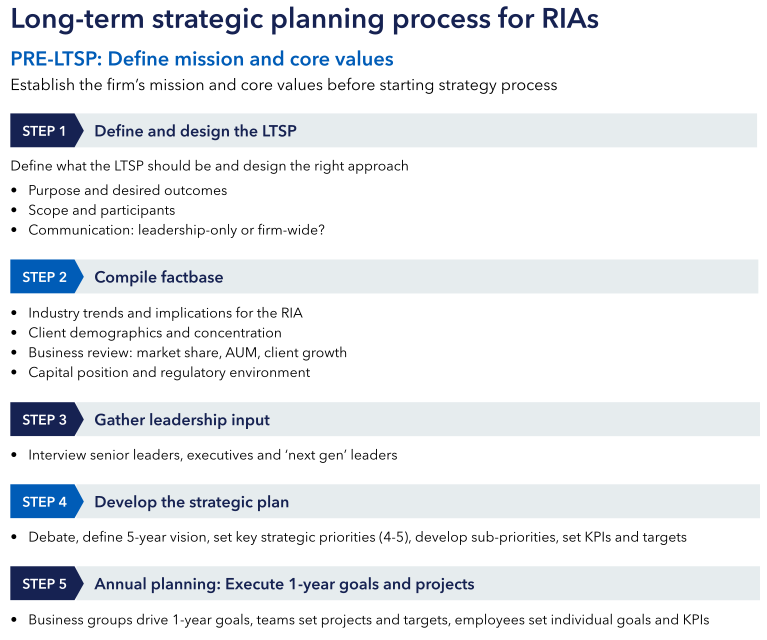
Nor had I thought about beginning the process by articulating our mission and core values — then setting a five-year vision for the firm and deciding on four to five long-term strategic pillars.
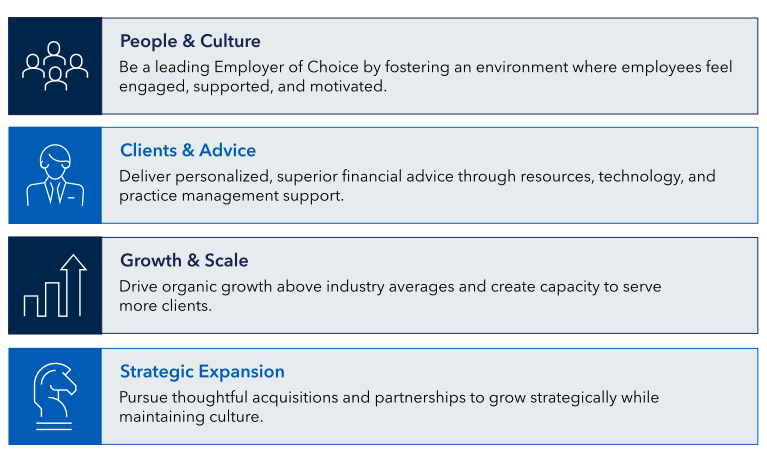
After the meeting, Capital Group came in and supported us as we adopted their method. We ended up settling on four strategic pillars.
Perigon’s four strategic pillars
Source: Perigon Wealth Management, 2026
How does the approach challenge your assumptions about leadership?
I used to think long-term planning was my burden — something the C-suite created and pushed through the organization. It’s painfully obvious in hindsight that people want to be included. And the more people you involve the better the plan and the company’s culture.
The executives do of course determine the mission, values and pillars, but then we get feedback from senior leaders at the firm — and together we develop five-year strategic objectives.
Ultimately, department heads roll the plan out to team leaders, who set annual goals and project targets. Then every team member defines their own goals and how their success will be measured. Having our employees help define their key performance indicators and goals is probably the biggest thing for me. And it goes both ways: I want every employee to hold us to account if they don’t have what they need to have a long successful career at Perigon.
How do mission, values and strategic pillars translate into real business growth?
They anchor your five-year strategic objectives and one-year goals and outcomes.
Take our Growth & Scale pillar to drive organic growth above industry averages. The five-year strategic objective for that pillar is to transition from a regional player to a national leader by capturing significant market share in certain verticals. We have specific measurable outcomes attached to these objectives. We aim to grow by a certain percentage over the next five years. And one of the one-year goals tied to that is to increase lead-to-customer conversion rates by a certain percentage.
These goals will then dictate the projects the firm must take on and the people we hire. For instance, in March we hired a managing director of digital strategy and a senior director of business development to help build and institutionalize a scalable system to drive organic growth.
The pillars and objectives also influence how we support our advisors.
Training and development programs for employees and managers is one of the objectives under the People & Culture pillar. We just put a cohort of young advisors through an organic growth training program introduced to us by Capital Group.
How does the LTSP help you maintain your culture?
It creates a lot of alignment, which is crucial if you don’t want to be a revolving door — it’s something many wealth advisory firms struggle with.
It helps us remain consistent in our messaging throughout our offices and our people. We continuously echo our long-term goals at every partner meeting or town hall — who we are, who we want to be and how we want to align around our long-term goals, which are here to stay.
Having the LTSP spelled out in this way gives people who are joining out of college a better idea of Perigon’s culture. It demonstrates how we want to support everybody’s success and that we want them to have a long career with us.
How did you solve the problem of getting a shared direction?
We started by developing a fact base: What we considered were the major industry trends, what our client base is, our market share is and so forth.
The Capital Group innovation and strategy team then came in and guided us on the critical design questions we needed to answer before developing the plan, things like whether we wanted the pillars to be a shared vision for the firm, who would set the strategic pillars and whether we will cascade the LTSP down through the firm or only to a certain level of management.
Source: Capital Group, 2026
Speaking to [Capital Group CEO] Mike Gitlin about his experience with his firm’s own LTSP also put things in perspective for me. We were talking about how different firms in the industry were dealing with the need to retain talent and he told me not to worry about what other RIAs are doing — just make Perigon the best it can be. That really resonated.
He also said that I shouldn’t be concerned if some parts of the LTSP progressed more quickly than others. It doesn’t mean the LTSP isn’t working, just that patience is needed in some areas more than others.
And most importantly, he emphasized consistency. He said he anchors his meetings with direct reports by returning to Capital’s mission and strategic priorities.
Are there signs that your LTSP is working?
It’s already changed how we operate. The LTSP is now what we begin with at partner, shareholder, management and town hall meetings. We’re currently inviting our directors to choose which pillar they find most appealing and to determine how they can strengthen those specific strategies.
Now, rather than constantly changing plans, I look forward to executive discussions where proposals must align with a strategic pillar. And if they don’t, we can ask a simple question: Why are we doing this?
I believe the RIAs that do this kind of long-term strategic planning work and invest in their people and culture will be those that stand apart from the rest over the next 10 years of industry consolidation.
And I often think about how much more we could have accomplished over the past decade if we’d put this long-term strategic plan in place sooner.