Client Conversations
 Jay Mooreland
Artificial Intelligence (AI) can build financial plans, optimize portfolios for tax efficiency, answer client questions at 2 a.m. — and never take a vacation.
But can it talk a client off the ledge?
When markets plunge or the urge to go all-in on Dogecoin strikes, clients may seek out a human — not a chatbot. That emotional connection, often underplayed as a soft skill, may now be one of the most valuable competitive tools advisors have.
“The one thing AI will never be able to do is look a client in the eye and say, ‘I know how you feel,’” says Jay Mooreland, advisor, author and founder of the Behavioral Advisor Academy. “If that’s our only edge, then the most successful advisors will be those who hone skills to create the best psychological experience for clients.”
As it turns out, handholding is in high demand. Investor anxiety hit five-year highs in the first half of the year, according to an online survey conducted in May by Allianz Life.1 And the angst hasn’t abated, if the level of cash on the sidelines is any guide: Investors are sitting on a record $7T in money market assets.2
At the same time, AI is freeing up advisors to focus on making stronger emotional connections with their wealthiest clients. Now that AI can take on more tedious tasks, like note taking, advisors are finding more time to polish the high-touch client services that need finesse: legacy building, helping with family dynamics and determining retirement aspirations.
It appears more advisors are upgrading their skills as a result, through online courses, coaching and certification in skills that have more to do with therapy than finance.
Putting financial therapy into practice
Once seen as a bear-market specialty, advisor interest in behavioral finance coaching and certification has increased in the past year, according to Mooreland, even amid strong equity markets. A 2024 survey by fintech firm Orion found that 33% of advisors were already using behavioral finance techniques in their practices, and another 43% planned to do so in the three years ahead.3
Behavioral finance coaching isn’t just about spotting biases anymore — it’s about mastering emotional strategies. Top coaches like Mooreland teach advisors cognitive behavioral therapy techniques, how to decode client body language and adapt their approach to each client’s psychological makeup.
The emphasis is on counselling clients persistently, over years; not just when markets blow up. The ultimate goal is to steadily reduce anxiety around market moves and build long-term resistance to irrational decision-making that can derail long-term investment plans.
“Good behavioral coaching is not just knowing how to talk a client off the ledge. It’s about making sure they never get to the ledge to begin with,” Mooreland says.
Some industry associations and established certification programs are also embellishing their behavioral finance courses and offerings. In 2025, the Certified Private Wealth Advisor (CPWA®) program increased the behavioral finance weighting in its exams.4 It also added emotional heuristics and coursework on psychological issues affecting younger generations who inherit assets — called “Sudden Wealth Syndrome” by therapists.5
In the summer of 2025, the Financial Planning Association launched its FPA® Competency Model™.6 Advisors can use the comprehensive digital platform to test their proficiency across six behavioral domains.
Meanwhile, the fields of financial planning and mental health are blurring, with the proliferation of financial therapy certifications in the past few years. Some are open to both certified financial professionals and therapists and require not just coursework and exams but also hundreds of hours of counseling experience for certification.7
Therapeutic techniques: A dose of tough love
There are many cognitive biases advisors must be prepared to redirect: Loss aversion, fear of missing out, recency bias and the “hot hand fallacy” that leads people to believe prior success is predictive of future performance.8
Dealing with clients in the moment of an irrational response often varies according to the bias that’s triggered. Yet methods built on cognitive behavioral therapy and narrative therapy practices share a common foundation. Case in point: Capital Group’s 4-box conversation framework, designed to help advisors address any client concern by starting with acknowledgement and moving to opportunity and action.
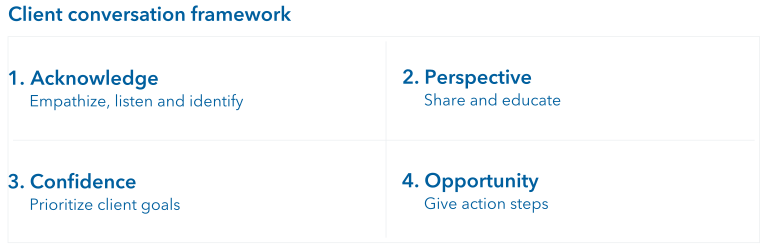
Source: Capital Group
Mooreland’s instructions are designed for constant use and are paired with advisor training on how to read a client’s mannerisms and personality traits, so they can adapt their own communication style.
Here’s a high-level example of how he would instruct an advisor to deal with loss aversion triggering a client’s wish to pull out of the market and go to cash:
Stall the reaction
The fear-and-flight response has been triggered. Building in time before the conversation can help clients compose themselves. Stalling could be anything from “Could you wait while I print out your investment plan?” to delaying a meeting for 48 hours.
Stay on their side
“You must always stay on the same side of the table as the client,” says Mooreland. “It’s important to validate a client’s comments, even when their feelings or conclusions may seem irrational.” Let the client speak without interruption, then respond with something along the lines of: “I completely understand how you feel. I’ve felt that way myself. I understand why you want to go to cash.”
Make them feel normal
Reassure them that their reaction is completely natural: “Everyone feels anxious right now.” Let them know we all have the same tendencies.
Pivot without ‘but’
Use more constructive segues to shift the conversation once they feel validated. For example: “Before we talk about going to cash, let’s revisit your plan … ”
Ask uncomfortable questions
Depending on the client’s personality, introduce discomfort with questions like: “What will make you know it’s time to re-enter the market?” Let them know you can’t tell them, because no-one can predict the future. Add that going to cash means they will have to be right twice — when to sell and when to get back in.
Introduce uncertainty
Meet their uncertainty with more uncertainty. Ask: “What if you sell and then the market moves higher? What will you want to do?”
“We want the idea of abandoning the plan to feel less comfortable and more uncertain than staying the course,” says Mooreland. “It reframes the ‘safe’ move of going to cash as the riskier choice.” This isn’t a one-size-fits-all solution. Some clients need a gentle nudge. Others respond better to uncomfortable questioning. But having a system to manage behavioral risk — and tailoring your delivery to the client’s psychological makeup — is the objective.
An advisor’s own mental health is also part of the equation. In his Handbook of Behavioral Finance for Financial Advisors Mooreland recommends advisors to be more up-front and honest about the awkward truths about investing and advising, for their own sake as much as the client’s.
Don’t answer every question a client asks is one of his biggest pieces of advice. “Clients ask things no one can answer — like when the next recession will hit,” Mooreland says. “Trying to answer only encourages speculation and sets you up to be wrong. Instead, say: ‘I could give you a rough guess, but that wouldn’t be a productive use of our time. I’d rather focus on those things we know and can control.’”
Also, don’t always be positive. “Tell the truth about all possible outcomes. A diversified portfolio may limit downside in bear markets, but it can underperform the S&P 500 index9 during rallies.”
Getting clients to a Zen state with their financial life is a tall order and the most successful advisors will probably be those who complement their therapeutic skills with AI. There are AI powered applications now able to synthesize data from financial transactions, social media posts and other online behavior to uncover hidden patterns, sentiments and biases in individual investors.10
Reduce advisors’ stress
The work will be worth it. After all, helping clients stay calm in volatile markets is more pleasant for all involved — and core to building wealth.
1Allianz Life, “Allianz Life Study Finds Record High Investment Anxiety,” June 24, 2025
2Investment Company Institute, “ICI Reports Money Market Fund Assets,” Oct. 2, 2025
3Orion, Advisor Wealthtech Survey, March 2024
4Investments & Wealth Institute, “Investments & Wealth Institute Announces Updates to Certified Private Wealth Advisor® (CPWA®) Certification Program,” March 12, 2025
5Investopedia, “Sudden Wealth Syndrome (SWS): Definition, Causes, and Treatment,” Sept. 1, 2024
6Financial Planning Association, “FPA Launches Groundbreaking Competency Model to Shape the Future of Financial Planning,” June 11, 2025
7eMoney, “10 Financial Psychology Certificates and Designations for Advisors,” Aug. 3, 2023
8Jay Mooreland, Handbook of Behavioral Finance for Financial Advisors, 2025
9The S&P 500 Index is a market-capitalization-weighted index tracking the performance of 500 leading publicly traded U.S. companies, widely used as a benchmark for the overall U.S. equity market.
10Capgemini, “Gaining HNWI market share: embracing AI-powered behavioral finance,” June 25, 2024
The indexes are unmanaged and, therefore, have no expenses. Investors cannot invest directly in an index.