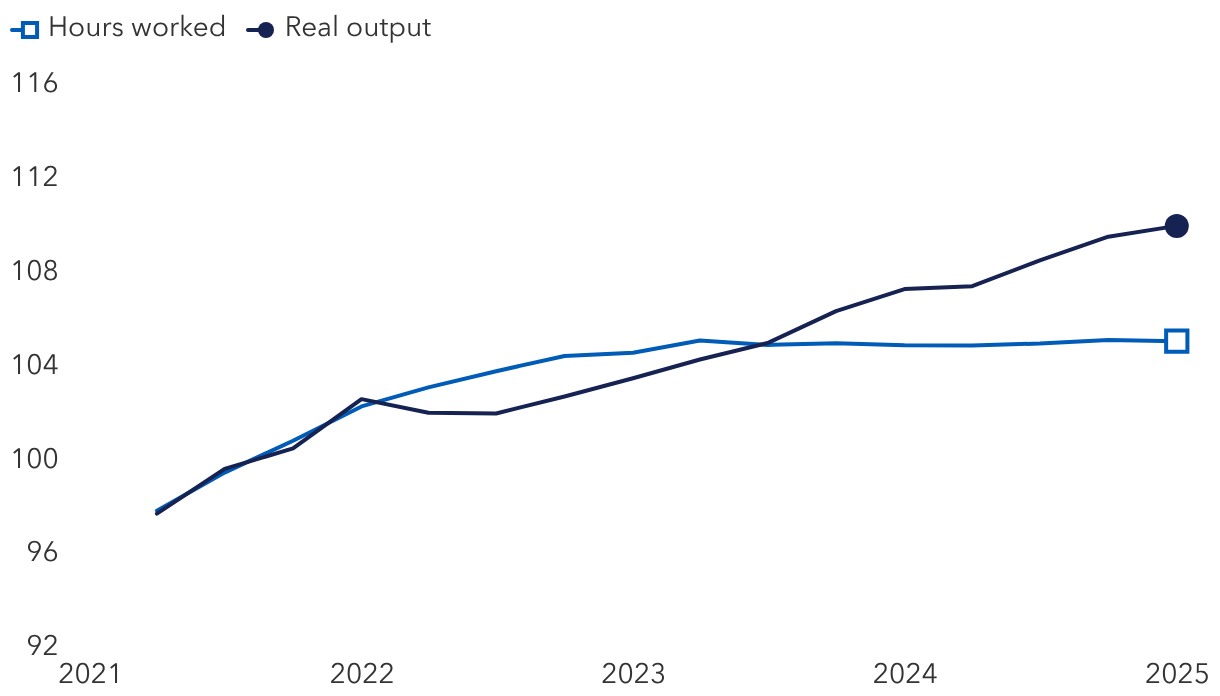
Franz notes five criteria must be met for companies to benefit from AI productivity gains.
- The task being improved must matter to the company’s overall output.
- The gain must be captured by the firm rather than retain a private advantage for the employee.
- The surrounding workflow must scale alongside it.
- Managers must be willing to reorganise how work gets done.
- Competitors cannot immediately force those gains to be passed to customers.
“If any one of those breaks, then the worker-level improvement does not show up one-for-one in company profits, overall production, or in the macroeconomic data,” he says.
Franz believes AI productivity gains are likely to be uneven, creating what he calls a jagged edge across the economy. Some companies will experience company-wide improvements, particularly in areas like customer support, insurance claims processing and select software workflows.
In other corners of the economy, AI’s impact may be smaller. “Elite legal and advisory work, health and medicine, and organisations where the hard part isn’t producing more things but converting analysis into high-quality decisions may experience much lower gains from AI,” Franz concludes.
AI systems are nowhere near human intelligence
In certain tests, AI systems can outperform humans with PhDs, but that is not the kind of intelligence that replaces human work, according to Mark Casey, an equity portfolio manager. “AI systems are pattern recognisers and producers. They don't have a grasp of what a bicycle or bicycle seat is. They're making statistically valid guesses, but they're still guesses.”
According to Casey, AI innovation has a long way to go before it can reliably replace humans in many real-world tasks. “Simple changes to the context of basic games such as tic-tac-toe or tasks requiring an understanding of how the world works can expose their limitations,” he says. This leaves a wide gap for humans to fill based on their experience, understanding of context and creativity.
“People who work with words and numbers may feel especially exposed given how these machines are optimised to produce both,” Casey explains. “But success isn’t defined by the ability to write or code. Instead, the hardest part is figuring out what customers want and how to deliver on those needs.”
Most layoffs aren’t AI-related
Warnings of an AI-fuelled jobs apocalypse are likely overstated. “We are still in the early stages of AI implementation, and many companies don’t know what the impact will be on employee productivity,” says Steve Watson, equity portfolio manager.
“I would take announcements of AI-related job losses with a dose of scepticism. Generally, the reasons for headcount reductions are less about AI and more about fundamentals of the business, including increased competition and higher cost pressures.”
Several companies across technology, e-commerce and finance hired aggressively during the pandemic to meet surging demand. Those same companies likely found themselves overstaffed as demand cooled and interest rates rose. “AI offers a convenient explanation for cuts that were already justified by lower earnings growth and a more normalised consumer spending pattern,” Watson adds.
“Executives are attuned to their stock prices and would rather say ‘we are reaping the benefits of AI implementation and therefore will be a leaner company,’ rather than admit their margins and business segments may be suffering.”
Vibe coding has its limits
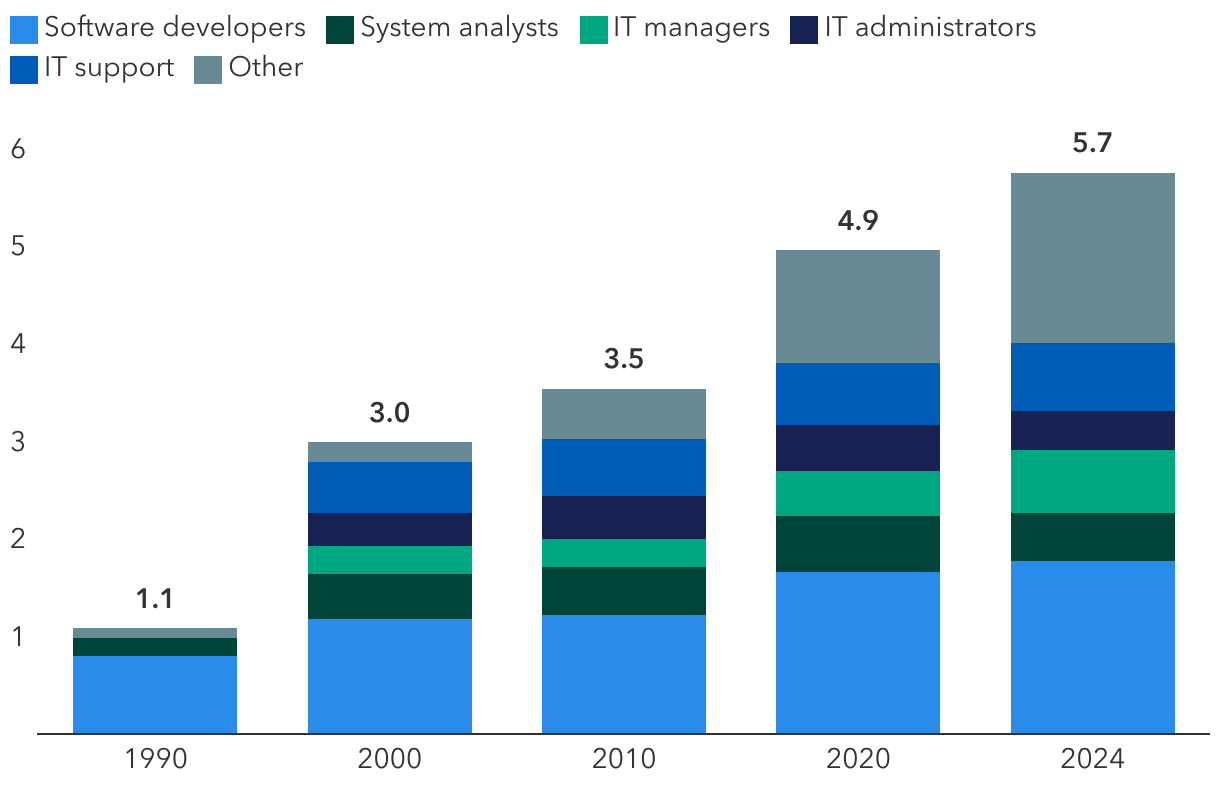
The impact of AI on the labour market is a theme that touches every business, sector and geography. For consulting and software companies, there are existential questions about whether their customer base will continue to outsource, says Rob Lovelace, equity portfolio manager.
The answer may depend on who you ask. CEOs often suggest outsourcing and hiring may decline, while chief technology officers are more guarded, Lovelace says. “They’re seeing that we may actually just be hiring different types of consultants and workers to help us. The reality may be that the complexity of work has shifted elsewhere, so companies may need to hire more people to do other things. Ultimately, the savings in time and efficiency will be large, but the reduction in head count may be a lot less than what everyone’s predicting AI will bring.”
There is also the reality that most people do not want to do everything themselves. Just as homeowners may watch YouTube videos to help them unclog a drain but still call a plumber to install a water heater, businesses may use AI tools but still rely on experts to get critical work done right. “Though information may be more readily available, the desire for expertise, efficiency and accountability keeps humans firmly in the driver’s seat,” Lovelace explains.