Elections Midterm impacts on AI data centres, tariffs and Iran

In the aftermath of the US midterm elections, a big blue wave of Democratic Party victories has raised important questions about three critical issues central to the US economy and markets.


How will the coming sea change in American politics affect the artificial intelligence boom, global trade deals and the outcome of the Iran war? The American people have spoken at the ballot box, but how will that sentiment translate into real-world events? Three of Capital Group’s most experienced policy advisers offer their views.


The politics around AI data centres will improve


Matt Miller, political economist


Given the sharp selloff in AI-related stocks post-election, you may be surprised to learn that I think the political backlash against data centres will ease, not worsen, in the year ahead. That doesn’t mean there won’t be a lot of noise along the way, and some near-term delays, but my hypothesis is that although the costs of the data centre build-out will rise, the quantity of compute sought will be politically achievable once new leaders settle in to govern.


What leads me to this emerging view? The coalition behind the data centre build-out knows it has fundamentally botched the politics on this issue and is moving aggressively to fix it. Based on what I’ve learned speaking with AI executives, investors and political strategists, it’s clear they are working together to come forward with a new framework of more generous, responsible and transparent offers to communities affected by data centre construction. The commitments may include: no impact on water supply and quality; no impact on utility rates, along with a readiness to throttle energy use if needed at times of peak demand; and appropriate protections against excessive noise and environmental impacts. Beyond that, there may be a need for tax contributions or related investments that assure an unambiguously positive influence on communities.

Four potential paths in the AI data centre build-out story

A quadrant chart lays out the varying scenarios and industry implications created by the buildout of AI data centers.

Sources: Capital Group. Scenarios reflect analysis of Capital Group’s Night Watch team as of October 2026, and they are not predictive of future outcomes. ROI: return on investment. REITs: real estate investment trusts. Hyperscalers are large-scale cloud service providers that offer computing power and storage to organisations and individuals globally. Neoclouds are specialised cloud infrastructure providers dedicated to AI workloads.

As new benefits from the pro-data centre coalition become clearer, I believe public opinion will shift. All the pre-election calls for moratoriums have been politically sufficient, yet ultimately flexible, positions for officials of both parties to take as community opposition has risen. It shows voters they are being heard, but it also leaves the door open for win-win negotiations to proceed in states with new leaders, such as Texas, Ohio and Georgia.


A year from now, I believe this will be a big piece of the data centre construction story. From an elected official’s standpoint, the positioning is excellent. They can show toughness by pushing back against big tech firms that voters don’t trust — and then deliver serious protections and broader community benefits for which they can take credit. This may result in higher costs for AI development. I would urge investors not to overreact to short-term political noise, particularly when you see tech executives called before Congress or even investigated. Beyond the headlines and given some time for a new political narrative to take shape, we are in the process of moving to a better long-term place for the data centre build-out.


US trade leverage waning post-midterms


Tom Cooney, international policy adviser


For the next two years while President Trump remains in the White House, other countries will be recalculating their relationships and leverage with Washington, DC. My base case is that we will see more pushback from abroad and even harder bargaining on trade and tariffs, but not a total break with Trump because he can still inflict damage in a trade-war scenario.


China will prioritise “constructive strategic stability” as its primary objective for the next two years, continue de-risking from the US, and will not seek any “grand bargain” that could well expire in 2028. Canada, Brazil and India will feel even more emboldened to resist overly generous trade concessions. They would prefer deals and stability, but their leaders will be rewarded at home for hanging tough against Trump.

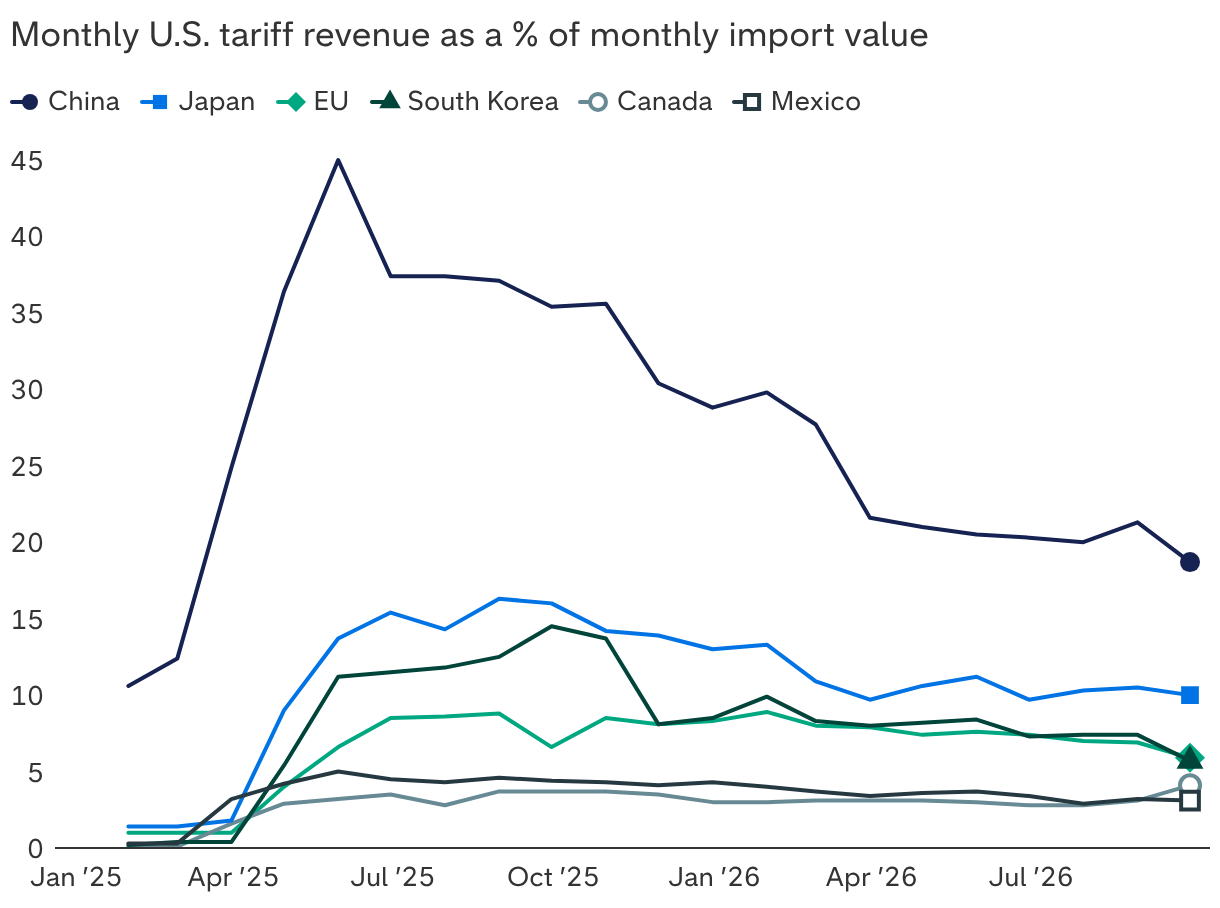
US tariff revenue has declined from its peak early last year

Sources: Capital Group, Peterson Institute for International Economics (PIIE), US International Trade Commission (USITC). Figures reflect PIIE calculations using USITC data. Total import value includes cost, insurance and freight. As of 30 September 2026.

Japan, South Korea and Europe will seek to avoid trade conflict, but I am now even more sceptical than I already was that they will actually deliver anything close to the exorbitant investment levels they agreed to in earlier trade deals with the US. They will make some investments in the US, of course, because it continues to offer many viable projects with potentially good returns. But I would not count on the European Union to deliver anything like the previously agreed $600 billion or Japan to deliver $550 billion by end of 2028, for example.


In my view, the lesson from the US midterm elections, as well as the 2024 general election, is that the American public is taking turns punishing political parties for their failure to deliver what matters most — fixing problems at home of inflation, affordability and economic opportunity. The 2024 election did not signal a permanent right-wing realignment, nor does the midterms’ “blue tsunami” signal the same for left-leaning political leadership. Neither party owns the electorate, and American voters are identifying less with either party.


The only certainty is that we are nearing the end of the Trump era, and he will resist losing primacy as he now must contend with a Democratic Congress. This dynamic sets the stage for further contention and volatility ahead. I expect President Trump will be more restrained than ever domestically by the courts and Congress, so this will cause him — like many presidents in the final two years of the second term — to lean into foreign policy where he has more leeway, as well as legacy projects seeking to leave his physical mark on Washington landmarks.


Ending the Iran war won’t be easy or quick


Talha Khan, political economist


The US midterms have reduced the immediate risk of another American attack on Iran, but they may have made the war harder to end. The political costs of renewed escalation have risen for President Trump, making it more attractive to maintain economic and military pressure while giving diplomacy more time. But the election has also complicated the search for an exit. Washington and Tehran remain locked in a game of cat and mouse. Neither side wants to offer concessions that could hand the other a strategic victory. The problem, as always, is not whether both sides ultimately want an exit, but how we get there.


What has changed post-midterms is the immediate risk of deliberate US escalation. That risk has fallen, but it is certainly not zero. Following Trump’s conversation with the Qatari prime minister, another round of US strikes no longer appears to be the immediate base case. Trump has explicitly kept the military option open, but for now appears to have concluded that the uncertain benefits of another round of strikes do not justify the military, economic and political costs.


Instead, Trump appears to have chosen economic pressure over military escalation, at least for now. The launch of “Operation Iron Gate” points to an effort to tighten the Iran blockade further, constrain its ability to export oil and allow that pressure to accumulate, while keeping substantial US military power in the region as a credible threat. That also buys more time for diplomacy. If talks progress, Trump can argue that maximum pressure forced Tehran back to the table. If they fail, the military option remains available.

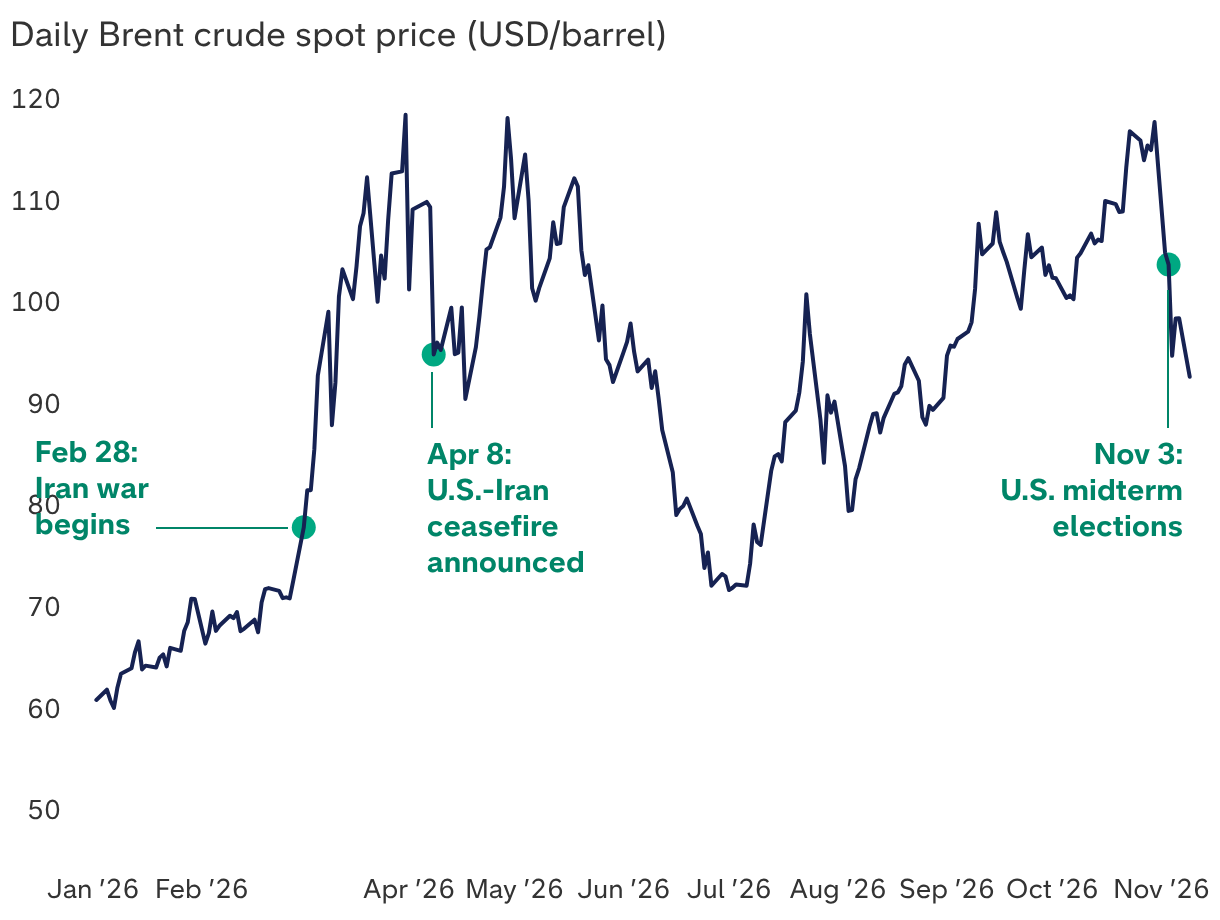
The US-Iran conflict has sparked a sharp rise in oil prices

Sources: Capital Group, Bloomberg, ICE, Reuters. As of 9 November 2026.

However, the absence of an immediate US strike should not be confused with de-escalation. Iran’s response since Trump’s announcement suggests very little willingness to soften its existing negotiating position. If anything, the midterms appear to have strengthened Tehran’s belief that time is working in its favour. Iran does not need to defeat the US militarily if it can survive, refuse to capitulate and impose enough economic and political costs that Washington eventually loses the appetite to continue.


That creates a central problem: Washington may prefer the status quo, but Tehran does not. An indefinite blockade is not a passive equilibrium for Iran. If Washington is going to prevent Iran from exporting its own oil and further squeeze its economy, Tehran has every incentive to demonstrate that this comes with a price. That could mean further attacks on tankers, disruption to regional shipping, or eventually broader retaliation designed to raise the economic and military cost of maintaining the blockade.


So, the nature of the escalation risk has changed rather than disappeared. A deliberate US decision to initiate another major round of military operations looks less likely. But the risk of escalation emerging from the blockade remains significant: Iran increases pressure on shipping or other regional interests, the US responds, Iran retaliates, and both sides find themselves back in an escalatory cycle that neither originally intended.


I therefore expect divergent short-term and longer-term outcomes. Near term, the risk of deliberate US escalation has fallen, and diplomacy has been given more runway. But the probability of a prolonged and inherently unstable standoff has increased. Unless Washington and Tehran can find a formula that allows both sides to claim some degree of success, the increasingly plausible end-state is an uncomfortable and volatile stalemate, potentially through the remainder of Trump’s term. From a longer-term perspective, the US midterm elections have marked the beginning of the end of the war.

Matt Miller is a political economist with 35 years of experience (as of 12/31/2025). He holds a law degree from Columbia University and a bachelor's from Brown University.

Tom Cooney is an international policy advisor and has 32 years of foreign affairs experience (as of 12/31/2025). He holds a master's degree in international business studies from the University of South Carolina and a bachelor's degree in communications from Cornell University.

Talha Khan is a political economist responsible for covering the eurozone and broader geopolitical issues. He has 17 years of investment industry experience (as of 12/31/2025). He holds a master’s degree in international political economy from the London School of Economics and Political Science and a bachelor’s degree in economics and political science from Macalester College.

Past results are not predictive of results in future periods. It is not possible to invest directly in an index, which is unmanaged. The value of investments and income from them can go down as well as up and you may lose some or all of your initial investment. This information is not intended to provide investment, tax or other advice, or to be a solicitation to buy or sell any securities.
 
Statements attributed to an individual represent the opinions of that individual as of the date published and do not necessarily reflect the opinions of Capital Group or its affiliates. All information is as at the date indicated unless otherwise stated. Some information may have been obtained from third parties, and as such the reliability of that information is not guaranteed.
 
Capital Group manages equity assets through three investment groups. These groups make investment and proxy voting decisions independently. Fixed income investment professionals provide fixed income research and investment management across the Capital organisation; however, for securities with equity characteristics, they act solely on behalf of one of the three equity investment groups.