Important information

This website is for Financial Intermediaries in Norway only.


If you are an Individual Investor click here, if you are an Institutional Investor click here. Should you be looking for information for another location, please click here.


By clicking, you acknowledge that you have fully understood and accepted the Legal and Regulatory Information.

Artificial Intelligence How to spot an AI bubble

If the recent spate of TV ads promoting artificial intelligence sparked a feeling of déjà vu, you’re not alone. Dot-com start-ups in 2000 and cryptocurrency companies in 2022 dominated TV commercials shortly before both suffered epic meltdowns.


This year’s ads have aired amid a surge of investments, increasingly fuelled by debt. Alphabet raised over $30 billion in USD-equivalent debt, including a 100-year bond, a rare structure that has not happened since Motorola’s 1997 issuance. With so much money pouring into AI, it is natural to wonder if today’s investments are signs of a bubble. Such moments are hard to call in real time, and even when bubbles burst, the underlying technologies can eventually change the world.


That is why our team is tracking signs of volatility as well as compelling long-term AI investment opportunities. Will this time be different? Only time will tell, but here are six areas we are watching.


1. Frothy IPOs


High-profile IPOs from a who’s who of generative AI companies are expected this year. Among those reportedly exploring their options: Anthropic, ChatGPT-maker OpenAI and SpaceX, which recently merged with xAI.


“It’s a logical step that has so far been missing from the AI boom,” says Chris Buchbinder, an equity portfolio manager. With the anticipation are concerns about valuations, circular financing and whether these companies can match investor expectations.


“One of the elements that inflated and sustained the 1990s tech bubble was accelerating revenue growth with the promise of profitability later,” Buchbinder explains. “These pre-IPO companies are the modern-day equivalent. When they eventually go public and investors get a more detailed glimpse into their financials, high growth rates are likely to be rewarded.”

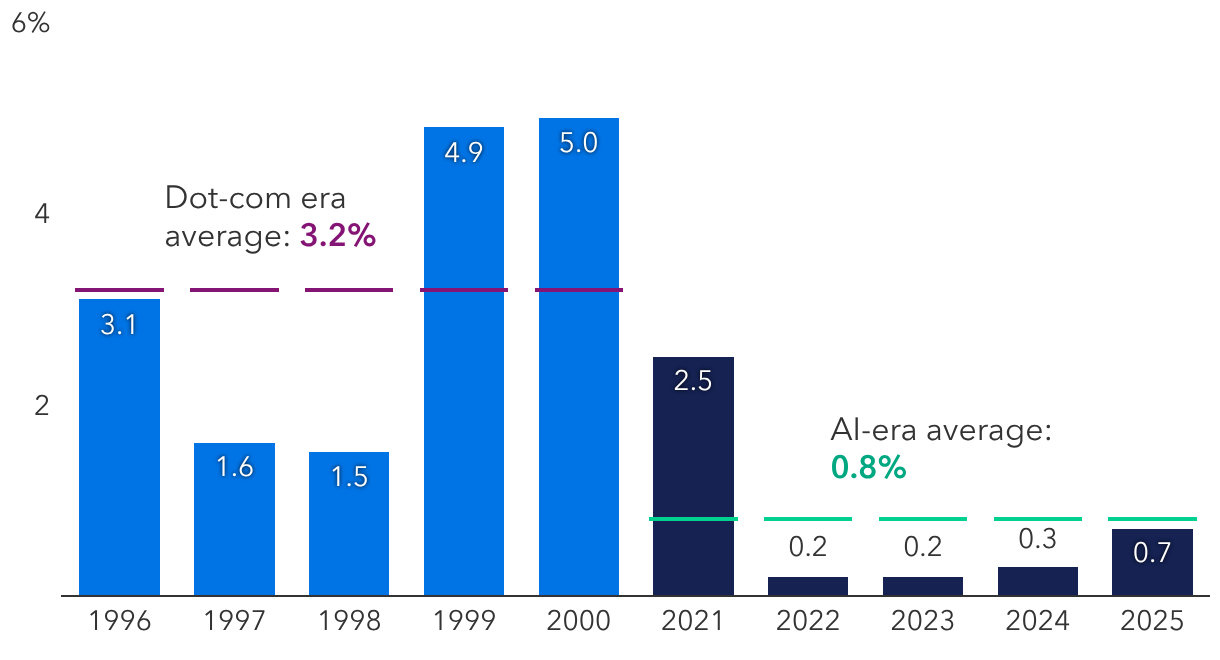
AI-era IPO market remains well below dot-com peak

Annual IPO value as a % of Russell 3000 Index

Sources: Capital Group, FactSet, FTSE Russell, London Stock Exchange Group (LSEG), Dealogic, US Securities and Exchange Commission. IPO market value is measured as end-of-day market capitalization after the first trading day. Annual IPO market value share of the total US stock market is calculated by dividing aggregate annual IPO market value by the Russell 3000 end-of-year market capitalisation. IPOs presented exclude ADRs, natural resource limited partnerships and trusts, closed-end funds, REITs, SPACs, banks and savings and loans, unit offerings, penny stocks with an offer price below $5 per share, and stocks not listed on Nasdaq or the NYSE. As of 31 December 2025.

Investors are especially eager to track OpenAI’s earnings growth. The company has committed $1.3 trillion in purchases by 2031 to suppliers including Oracle, CoreWeave, Microsoft, Amazon, NVIDIA and others. That concentration has turned OpenAI into a bellwether for AI’s growth story.


“As long as growth is sustained, funding is likely to remain available to OpenAI and other AI leaders,” Buchbinder adds. “At some point, things will slow down and the environment will become more difficult, but we aren’t there yet as we are still early in adoption and monetisation curves.”


2. Debt-fuelled growth


Alphabet’s 100-year bonds highlight the growing trend of hyperscalers leaning more heavily on debt, even as the commercial payoff remains uncertain. AI-related debt issuance jumped 112% in 2025 compared to the prior year, and 2026 is shaping up to be even bigger.


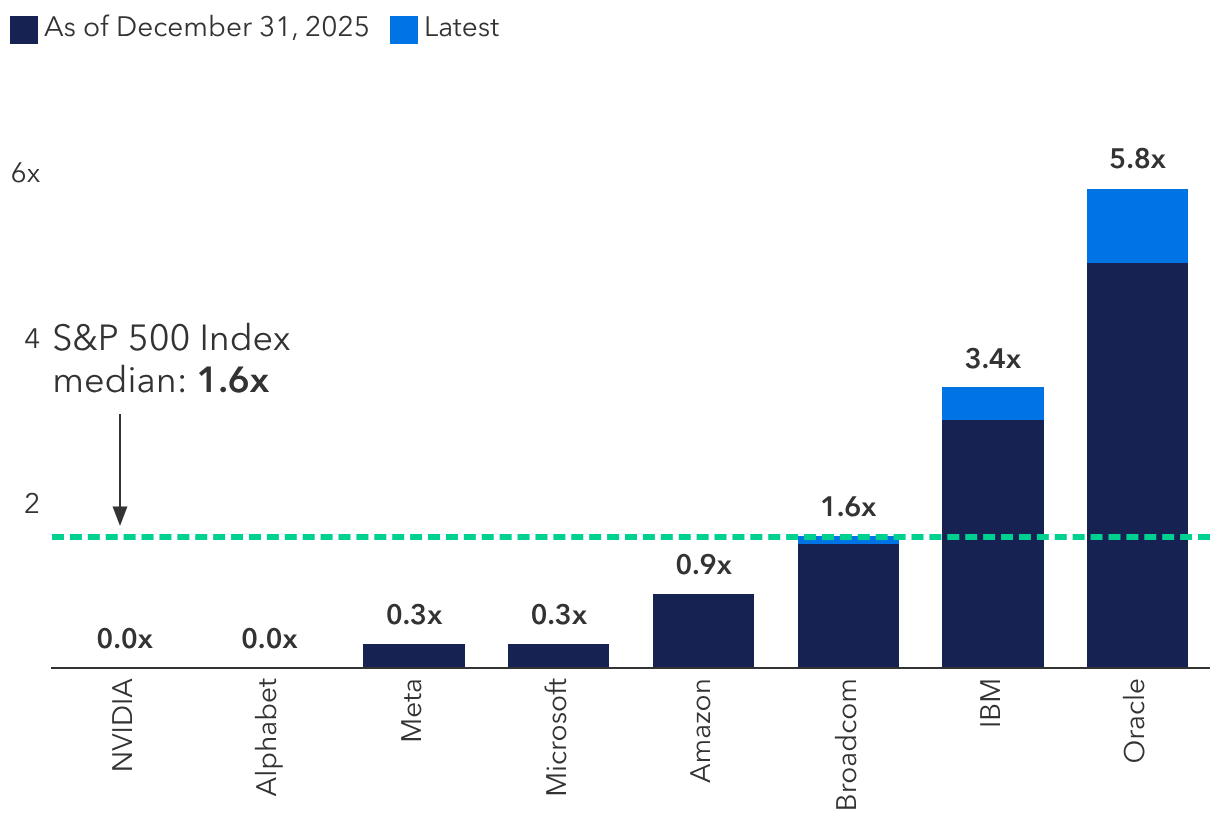
Although the sheer size of today’s issuances is making headlines, “these are high-quality companies that represent a sliver of the investment-grade debt market, which is a stark contrast to their dominance in the S&P 500 Index,” says Damien McCann, a fixed income portfolio manager.

Most AI buildout leaders have low leverage

Net debt to trailing 12-month EBITDA

Sources: Capital Group, FactSet, Standard & Poor's, company reports. Specific companies shown are for illustrative purposes only and are meant to represent some of the largest and most direct participants in the AI ecosystem. Net debt represents total debt including short- and long-term operating lease liabilities less cash and cash equivalents; cash and cash equivalents exceeds total debt for both NVIDIA and Alphabet. Trailing 12-month EBITDA (Earnings Before Interest, Taxes, and Amoritization) represents the sum of the last four quarters of EBITDA. Quarterly net debt and EBITDA figures are provided by FactSet, based on most recently reported full-quarter figures as of 31 December 2025. “Latest” above represents additional debt issuance that occurred between 31 December 2025 and 10 February 2026.

Most of these companies currently have low leverage and are issuing debt to fund AI-related capital expenditure (capex), which helps optimise their capital structure. “Given their sizable cash reserves and healthy cash flows, they can likely fund these projects on their own, even when considering the increased capital expenditure,” McCann explains. “In my view, this reduces the systemic risks considerably.”.


McCann argues this is a sharp contrast to companies in the dot-com era. “Many tech companies in the late 1990s were operating with limited or even negative cash flow, relying heavily on equity issuances and more speculative venture capital,” he says. “Companies like WorldCom piled on debt and increased leverage considerably for their fibre network build-out while Pets.com raised large sums despite unproven demand.”


Importantly, several of today’s investment-grade debt deals have been issued at the parent company level, which offers many advantages, McCann says. Chief among them is that their value is tied to the collective cash flows and worth of the company. For example, Alphabet is the parent company of Google, YouTube, Waymo, DeepMind and other subsidiaries. “It’s an important distinction because you’re not lending to a structure that only exists to fund investments in AI.”


Still, investors have demanded additional yield to own AI-related bonds compared to similarly rated peers, a premium reflecting the large quantum of bonds issued, in addition to modestly higher issuer leverage and uncertainty about whether demand for AI will continue at the current pace.


3. Creative financing


Another concern is so-called vendor financing. Money is looping between the same companies, with start-ups and hyperscalers buying from one another and helping each other grow revenue. Case in point: Amazon and Google each invested billions in Anthropic, an AI systems start-up. In return, Anthropic agreed to use Amazon Web Services and Google’s services and products.


The 1990s saw similar circular arrangements with Lucent Technologies lending excessively to cash-strapped start-ups so they could buy Lucent’s equipment. Those customers eventually were unable to pay, forcing Lucent to restate revenue and take huge write-offs.


McCann believes a near-term house of cards scenario is unlikely for hyperscalers. “Unlike Lucent, they’re lending only a small fraction of their cash flows,” he says. “Their financial strength generally gives them flexibility to pursue alternative ways of funding their expansion plans, which may include off-balance sheet arrangements or project-finance deals.”


Meta, for instance, has a joint venture with Blue Owl Capital called Beignet Investor to build a supersized data centre in Louisiana dubbed Hyperion. Microsoft, meanwhile, has signed short-term deals with data centre providers called neoclouds that are viewed as operating expenses rather than long-term capital investments.


Because the AI build-out is still considered early, these non-traditional deals will likely increase in the coming year, particularly with private credit. “They may be attractive in certain instances but do require additional scrutiny from potential lenders because they are structured to limit the financial risks to the parent company,” McCann explains.


“While I believe in the transformative power of this technology, I’m not in any rush to invest in these deals. It’s going to come down to the individual structure and what the contracts look like, including an evaluation of the financial support provided by the hyperscalers.”


4. Overbuilding


If you build it, the thinking goes, growth will follow. In the early 2000s, telecom companies poured billions into fibre optic cable networks, believing demand for transmitting internet data was unlimited. What happened instead was an oversupply that led to massive asset write-downs and investor losses.


According to US economist Jared Franz, “It is important to remember that overinvesting is a feature, not a bug, of any major advance in technology.” At some point the companies will shift their focus to investing more efficiently.


Today, hyperscalers believe building more data centres is essential to expanding AI inference, or the ability to run generative AI models for everyday use. As Franz puts it, the infrastructure is required to take on more AI workloads tied to training and inference, with the latter requiring reliable, always-on computing to serve users in real time. "From an AI workloads perspective, the physical infrastructure needs to get built first before it can be populated with graphic processing units (GPUs), networking and storage to run the next generation of large language models."


Thus, investors pay close attention to the performance of new AI models and their updates, he adds. If gains begin to plateau, that could signal AI demand may not keep pace with spending. Nevertheless, Franz believes that the current capacity hyperscalers being fabricated over the next two years could be repurposed into other businesses if the scaling laws do not hold. “For some companies, there will be demand for that compute even if AI demand slows.”


5. Resource constraints


The availability of electricity has emerged as an urgent issue for AI’s growth potential, according to fixed income analyst Julian James. That is because data centres require memory, power, chips, copper and water. Obstacles in these areas could hamper infrastructure development, slowing capex spending by hyperscalers and pressure development timelines.


“When I met with utility sector CEOs in late 2025, many said that the availability of electricity and the extended timeline for data centres to be connected to the electric grid are the biggest constraints for expansion, which are required for the growth of AI,” he says. “The key bottleneck is a shortage of skilled workers capable of building new power plants and the transmission lines needed to connect new data centres to the grid.”

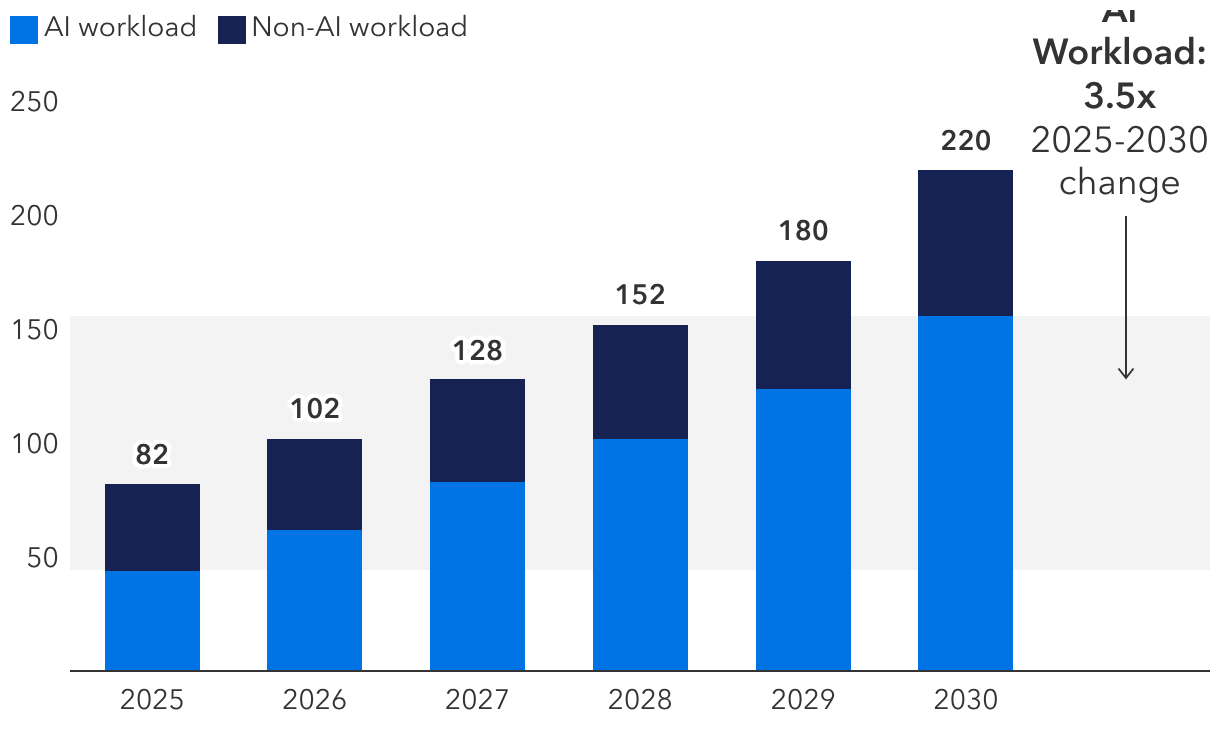
Data centre growth set to supercharge power demand

Estimated power demand from global data centers (gigawatts)

Sources: Capital Group, Gartner, IDC, McKinsey & Company, NVIDIA. AI workloads refers to resource-intensive tasks requiring large amounts of data processing related to developing, training and deploying AI models. Estimates as of April 2025.

For now, the US appears to have sufficient excess electricity to meet growing demand through 2028 or 2029. After that, without a significant increase in electric power generation, the pace of data centre growth could slow, James explains.


Utility companies have begun to invest more in their electric grid in the face of aging infrastructure and higher demand. “Overall capex for utility companies may jump to around $200 billion from about $130bn to $135bn in 2020, with as much as 20% of that tied to AI,” James says. Because utilities want to maintain their investment-grade ratings, he expects many will turn to equity or equity-linked financing to fund capex.


6. Slowing economic growth


It is impossible to talk about a potential AI bubble without understanding where we are in the economic cycle, says Franz. Hallmarks of late-cycle periods typically include sustained increases in inflation, interest rates, wages and other conditions that prompt the Federal Reserve to tighten policy.


Franz believes the US economy is currently in the middle stage of the cycle, a phase that is generally resilient. He sees long-term US productivity growth rising to 3% to 4%, which could keep wage gains elevated and support broader economic growth.


“Of course, there is always the potential for other external shocks to cause AI-driven stocks to fall dramatically,” notes Franz, citing breakthroughs that substantially reduce training costs or investors pulling back on data centre financing. “I believe we are in the early stage of the AI technology build-out, with demand continuing to outstrip supply.”


Over time, the contest to dominate AI will produce winners and losers, but today’s tech hyperscalers generate substantial earnings and free cash flow so a big bubble burst comparable to the dot-com era is less likely. “Every cycle will have some level of excess, and there will likely be moments of volatility, but this one appears to have more room to run,” he concludes.

Chris Buchbinder is an equity portfolio manager with 30 years of investment industry experience (as of 12/31/2025). He holds a bachelor’s degree in economics and international relations from Brown University.

Damien McCann is a fixed income portfolio manager with 26 years of investment industry experience (as of 12/31/2025). He holds a bachelor’s degree in business administration with an emphasis on finance from California State University, Northridge. He also holds the Chartered Financial Analyst® designation.

Jared Franz is an economist with 20 years of investment industry experience (as of 12/31/2025). He holds a PhD in economics from the University of Illinois at Chicago and a bachelor’s degree in mathematics from Northwestern University.

Julian James is a fixed income investment analyst with research responsibility for investment-grade utilities in the U.S. He has 16 years of investment industry experience (as of 12/31/2025). He holds a bachelor's degree in political science from the University of Georgia.

Past results are not predictive of results in future periods. It is not possible to invest directly in an index, which is unmanaged. The value of investments and income from them can go down as well as up and you may lose some or all of your initial investment. This information is not intended to provide investment, tax or other advice, or to be a solicitation to buy or sell any securities.
 
Statements attributed to an individual represent the opinions of that individual as of the date published and do not necessarily reflect the opinions of Capital Group or its affiliates. All information is as at the date indicated unless otherwise stated. Some information may have been obtained from third parties, and as such the reliability of that information is not guaranteed.
 
Capital Group manages equity assets through three investment groups. These groups make investment and proxy voting decisions independently. Fixed income investment professionals provide fixed income research and investment management across the Capital organisation; however, for securities with equity characteristics, they act solely on behalf of one of the three equity investment groups.