As a result, AI could amplify the country’s already robust industrial ecosystem, turning technological advances into real world products. “Many companies are building humanoid robots used for manufacturing and logistics tasks, replicating what humans do on factory floors and in warehouses,” says equity investment analyst Sugi Widjaja, who focuses on Asian technology companies. “They’re adept at the hardware side and continue to make progress on the software side, using lessons from the country’s autonomous vehicles industry.”
In a bid to gain global influence and market share, China has adopted an open-weight model that allows customers to securely use its AI. True open-source models allow full access to training data and code, while open weight does not. "This means that US companies can use cheaper Chinese open weights without sending data to China. They access them through cloud providers like Amazon Web Services or Microsoft Azure that host the models locally and keep everything compliant with US data and privacy laws," he explains.
Competitive coexistence
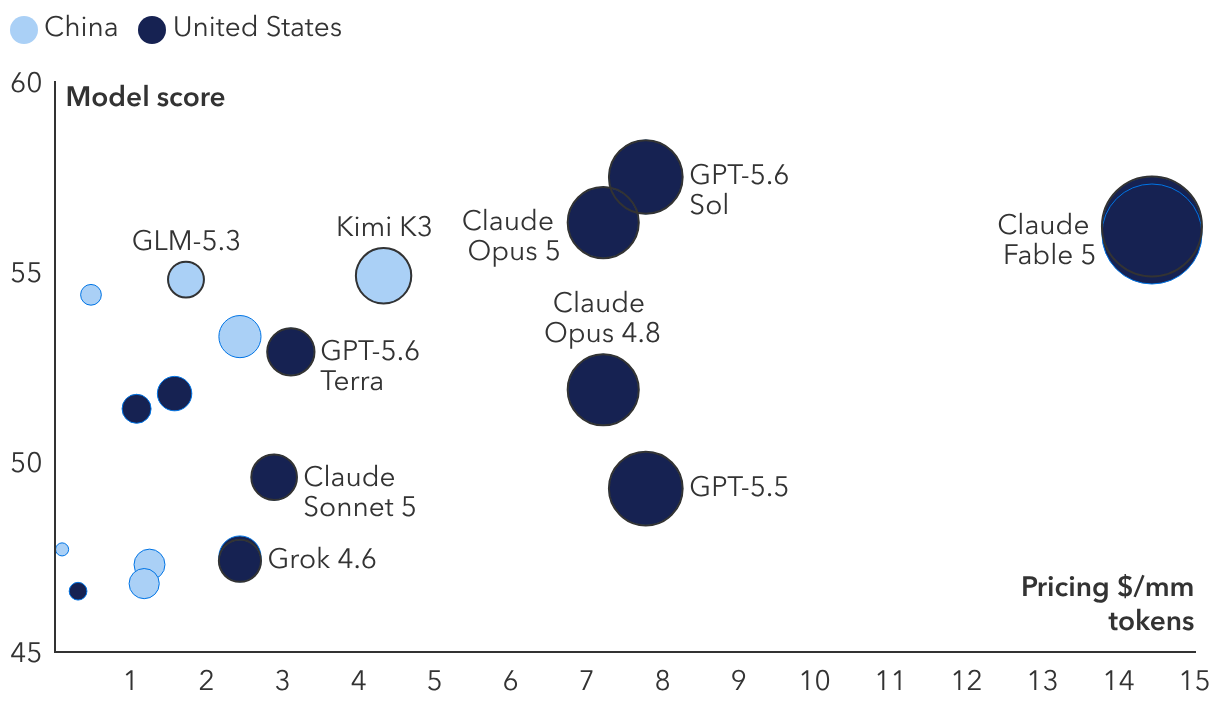
Rather than a winner-takes-all outcome, Kwan sees the two systems coexisting, where frontier US models capture the premium, high-stakes work while cheaper Chinese models handle the rest. "The best companies will likely always choose the most intelligent model for tasks where a 10% to 15% performance edge matters and becomes a competitive advantage over time. But for lower stakes jobs, if the Chinese model is good enough, they'll use the Chinese model,” she adds.
Casey agrees, noting there are already companies that route queries or projects toward the lowest overall price. “While Chinese models may be cheaper per token, they may require more tokens to complete a task accurately. Thus, companies like privately held OpenRouter have formed to switch between models depending on the task and accuracy required.”
He adds: “It’s too early to declare who will win on productivity and innovation, but the two systems will coexist given geopolitical tension and deep mistrust. Today, for example, in the infrastructure as a service market, although Chinese internet companies such as Baidu and Tencent offer very low prices, they aren’t widely used in the US and Europe.”
What does the US-China AI race mean for investors?
Few events have tested investor’s confidence in the sustainability of the US AI boom more than the rise of China’s open-weight models. “Given that AI spending now touches many companies in the US stock markets, volatility tied to the U.S. and China AI race will continue. Their developments are important to monitor as both are advancing at a rapid clip and have major implications for companies and society,” Casey says.
“So far, Chinese models have not undercut the case for US AI development, though the AI build-out cycle may be approaching the top part of the S-curve, where growth in new capacity slows even if overall demand continues to grow,” he explains. “I think at some point there will probably be a transition to companies that grow in line with the total amount of AI infrastructure already running rather than according to the new infrastructure built each year. An example is Amazon Web Services. Others like Meta could benefit if the price of AI chips declines, given it’s an input cost for the company.”
Franz concludes: “We know from prior technology cycles that leaders at the beginning are often not the leader at the end or in the middle. There's a lot of shuffling in leadership, and it's very hard to predict which companies will ultimately win. That’s why we are tracking this closely in the US and with on-the-ground research in China.”