“Price increases for major drivers of inflation such as car insurance and shelter, including rent, have slowed and are now helping bring overall inflation down,” Hollenberg says. “That cooling trend should continue as the job market shows signs of softening, and many businesses are reluctant to push through price increases.”
Still, inflation remains a key risk for bond investors given the scale of AI-related investment. “If capex continues to rise and accelerates growth before AI-related productivity gains show up, inflation could move higher. Under that scenario, the Fed could feel more pressure to embark on a renewed hiking cycle, which could push the yield on the 10-year Treasury above 5%. It’s not my base case, but something I’m tracking closely.”
Fed returns to pre-crisis playbook
As rates and inflation normalise, US Federal Reserve Chair Kevin Warsh is embracing a communication strategy that relies less on forward guidance, echoing the Fed’s approach before the global financial crisis.
“I’m comfortable with the Fed making fewer promises about where rates will be six or 12 months from now, but investors still need to understand what evidence would change monetary policy,” Hollenberg says. “If I have no idea what could cause the Fed to raise or lower interest rates, I will likely demand more compensation to hold long-term bonds. This may ultimately be an iterative process where markets learn Warsh’s reaction function over time.”
Uncertainty about Warsh’s reaction function after the Fed kept rates steady at its July meeting put volatility on full display. The 30-year Treasury hit a 19-year high of 5.3% in August before receding on Treasury Secretary Scott Bessent’s surprise move to increase buybacks of long-dated Treasury securities.
“Bessent is signalling to the market that the Treasury Department may intervene if bond yields move above levels it believes are justified by the fundamentals,” Hollenberg explains. “They can do that to a certain extent, but there are limits. If Treasury pushed that strategy too far, it could become more difficult to sell bills to fund those bond purchases and ultimately risk undermining demand for dollar-denominated assets.”
As the Treasury market whipsawed, the US hit an alarming milestone: The national debt surpassed $40 trillion, roughly double the amount just 10 years ago. Queen notes that worries about US borrowing have been around for decades and remain a top question from investors.
“The idea that the US won’t repay its debt in a currency that it prints is unlikely. The real concern is whether people will continue to buy additional Treasuries. If they don’t, borrowing costs could rise further and pressure the government to reduce deficits,” Queen says. “While that is certainly possible, the US economy remains one of the strongest in the world, with a large and very liquid government bond market. These factors should help prevent a near-term debt crisis.”
History shows stocks can handle higher rates
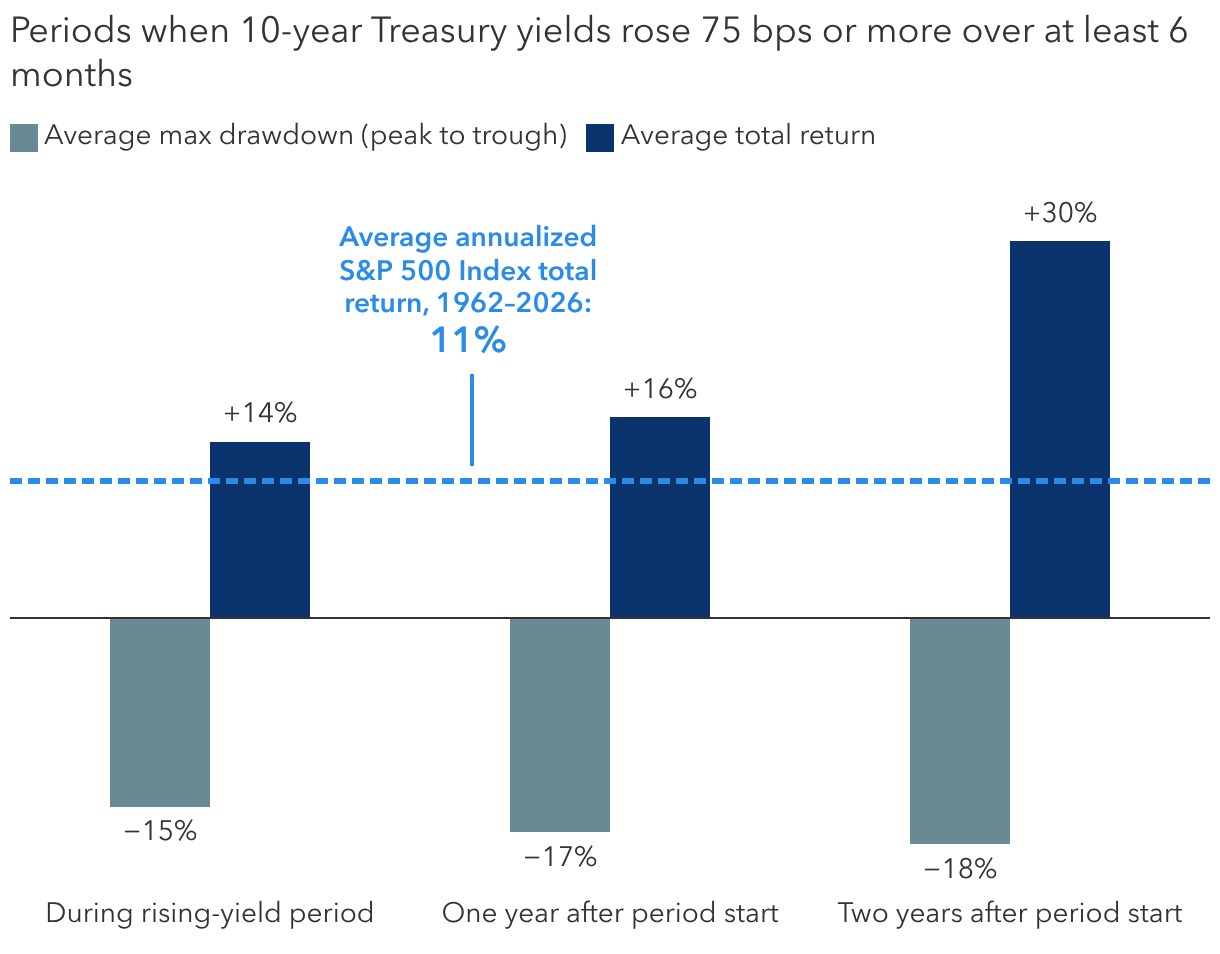
“Most rising rate environments correspond with economic growth, so they’re more common than investors may think,” says Cheryl Frank, equity portfolio manager.
“Markets tend to wobble when long-term rates jump 50 to 100 basis points, but generally shake it off, which is where we are today. Stocks typically begin to fall apart only after rates have risen much further — historically when long-term bond yields climbed 2% to 2.5%.”