Demographics & Culture America at 250 in six charts

For investors, America’s 250th birthday allows time for reflection. At 250, the US economy remains the envy of the world, even as the global system is undergoing dramatic changes. Below are six charts that highlight how it got here and where the country may be headed.


1. Small population, big impact


Since the signing of the Declaration of Independence, the US has grown from 13 colonies into a global superpower of roughly 340 million people, or 4% of the world’s population. “Westward expansion has helped the nation transform into an economic giant that today generates 27% of the world’s output. US companies rank among the world’s most valuable, while American sports, movies and pop culture continue to resonate with audiences worldwide,” says US economist Jared Franz.

The US remains a powerful force in the global economy

A series of boxes shows the U.S.' share of the global total across five categories. The U.S. accounts for 4% of world population, 27% of GDP, 83% of the top 100 firms by market capitalization, 88% of the top 50 sports franchises, and 98% of the top 50 highest grossing movies worldwide.

Sources: Capital Group, Box Office Mojo, Forbes, IMF World Economic Outlook, MSCI, RIMES, U.S. Census Bureau. Top 50 highest grossing movies worldwide are ranked in nominal USD, based on Box Office Mojo data as of 31 May 2026. Gross domestic product based on IMF World Economic Outlook data as of 2025. Top 50 sports franchises based on Forbes data as of 18 December 2025. Top 100 firms by market capitalization in USD based on the 100 largest constituents in the MSCI All Country World Index as of 31 May 2026.

2. Early adopters of new technology


Nearly two centuries ago, French sociologist Alexis de Tocqueville described America as “the most easily changeable society.” That framework has been especially visible in its embrace of technologies that expand growth and improve the quality of life for Americans.


The success of the Erie Canal helped spark a canal building boom in the 1820s, cutting transportation costs by 90% and connecting markets across the young nation. Railroads in the late 19th century extended the nation’s capacity to explore new lands and accelerated commerce. In the 20th century, mass-produced Model T cars, broad adoption of telephones and invention of computers boosted productivity and opened new markets.

Americans have often been early adopters of new technologies

Three line charts compare adoption rates of railroads, telephones and personal computers in the United States, Germany, the United Kingdom, France and Japan. The United States was among the earliest adopters in all three technologies and maintained higher per-capita adoption rates than most peers for much of each period shown.

Sources: Capital Group, Harvard Business School Cross-country Historical Adoption of Technology (CHAT) Dataset. Rate values interpolated between adjacent observations where source data is not available.

Today, artificial intelligence promises to be a long-term value creator. “Within every industry, companies will leverage AI to create differentiated competitive advantages,” says Jessica Spaly, equity portfolio manager. “Similar to how companies like Amazon and Home Depot changed retail during the digital transformation era, I think new and established companies will create moats for themselves with AI. We are still in the early stages, however, as the market is currently more focused on the chips, hardware and platforms that AI runs on.”


3. US dollar’s “exorbitant privilege”


French policymakers in the 1960s called the dollar’s status as the world’s reserve currency an “exorbitant privilege.” That advantage helped sustain decades of economic growth, military might and global influence.


“The US emerged from World War II as a nation that could lead global reconstruction efforts and provide stability, which helped pave the way for the U.S. dollar to become the world’s reserve currency,” says David Hoag, fixed income portfolio manager.


“Over time, this meant that the US could issue debt at lower yields than other countries, absorb currency risks, or even use the dollar to enforce sanctions. Especially during times of crisis, the US government generally has no problem financing a large budget deficit while at the same time being in full quantitative easing mode,” he explains, referring to the practice of central banks purchasing government bonds and other securities to keep interest rates low.


“The recent trend of central banks diversifying away from the dollar will likely continue,” Hoag adds, “but no currency is close to supplanting it as the world’s reserve currency.”

The US dollar’s dominance has shaped the modern world

A stacked bar chart shows the changing composition of global foreign exchange reserves from 1900 to 2025. Sterling dominated reserves prior to 1930, with the U.S. dollar becoming the leading reserve currency after World War II. Since 2000, reserve holdings are more diversified with the rise of the euro and other currencies, though the U.S. dollar remains the largest share.

Sources: Capital Group, Eichengreen, Mehl and Chiţu (2017), How Global Currencies Work: Past, Present and Future, Princeton University Press, Princeton, New Jersey. Selected years shown. Shares reflect disclosed global foreign exchange reserves at market exchange rates and may not sum to 100% due to rounding.

4. The innovation flywheel


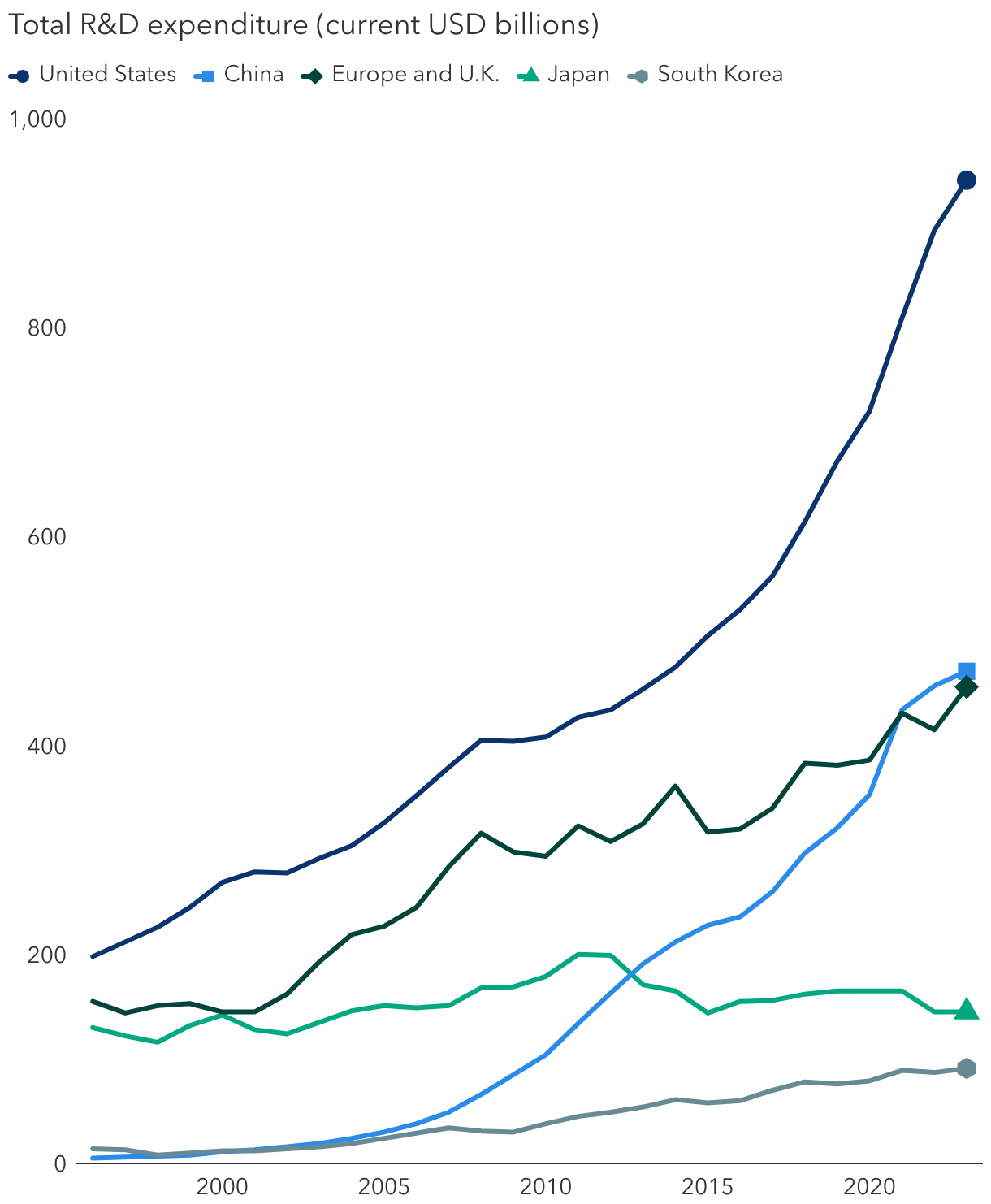
“The intersection of world-class research and development, as well as strong ties to academia and easy access to capital, are unique US advantages difficult to replicate elsewhere,” says Rob Lovelace, equity portfolio manager.


“Each reinforces the other and helps create a constant innovation loop.”

The US leads the world in R&D spending

Sources: Capital Group, World Bank: World Development Indicators. Figures shown are annual from 1996 to 2023, using latest available data as of 30 June 2026. Research and development (R&D) spending includes both capital and current expenditures across business enterprise, government, higher education and private nonprofit sectors.

Healthcare innovations in vaccines, surgery, blood storage and transfusion, chemotherapy and more have saved lives worldwide. “This is an industry built on decades of effort, where fewer than 5% of drugs succeed,” Lovelace says. “Yet capital continues to flow, in hopes of funding the next generation of treatments or drugs that help patients live better lives.”


According to Lovelace, “AI could accelerate drug discovery in the coming decades. If the technology can help identify which drugs are more likely to fail and those more likely to succeed earlier in the process, we could potentially raise the success rate to 10%. We might even be getting closer to actual cures for certain diseases.”


5. Resource rich


Across the country, the US has fertile farmland, abundant oil and gas reserves, and vast natural resources. Combined with technological innovation, these advantages help America prosper.


“A key turning point for energy independence came in the early 2000s, when the US commercialised hydraulic fracking and began to dramatically increase oil and gas production by applying pressurized liquid into shale rocks,” says Paul Benjamin, portfolio manager.


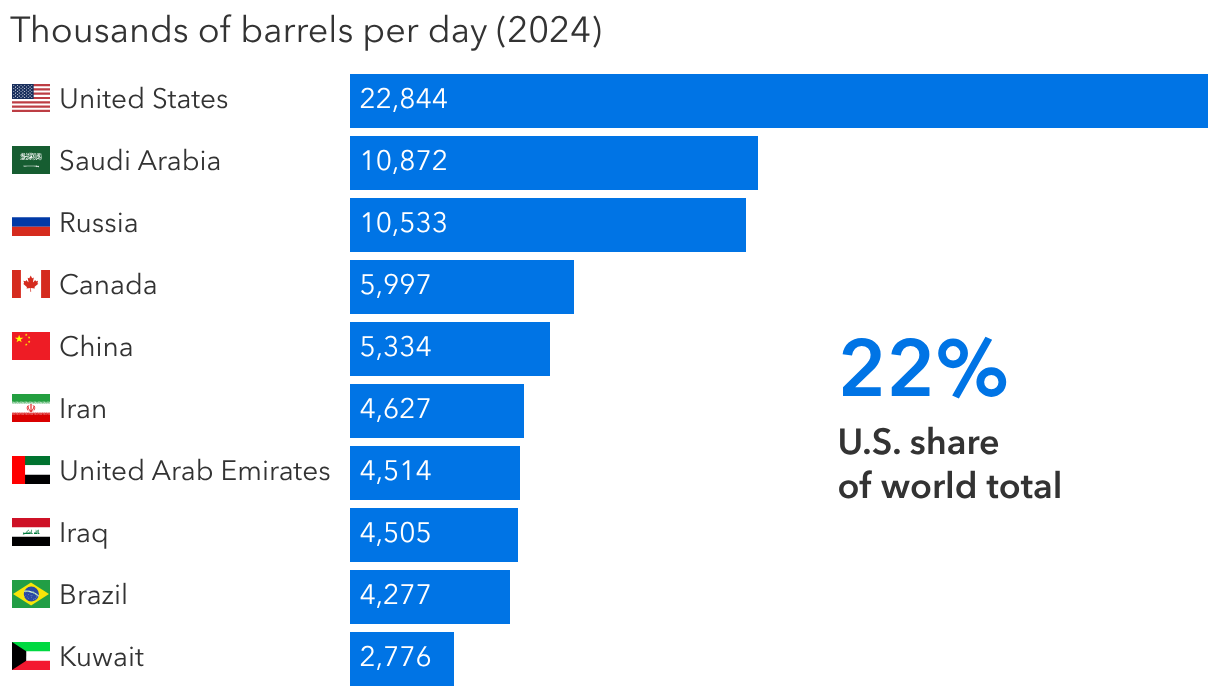
“Today, the US is the world’s largest energy producer, which gives Americans and its companies several advantages. Lower energy prices, particularly for natural gas and coal, which account for 45% of US primary energy consumption, mean companies can build manufacturing facilities here versus Europe or Japan where energy prices are more volatile.”


The US is also now more resilient to global energy price shocks. “Assuming disruption is short-lived, the US today can better weather war in the Middle East compared to decades ago,” Benjamin adds.

The US is the world’s top oil and gas producer

Sources: Capital Group, U.S. Energy Information Administration. Data includes petroleum and other liquids such as biodiesel, ethanol, liquids produced from coal, gas, and oil shale, Orimulsion, blending components, and other hydrocarbons. Latest data available is 2024 as of 28 February 2026.

6. Markets have shown resilience throughout history


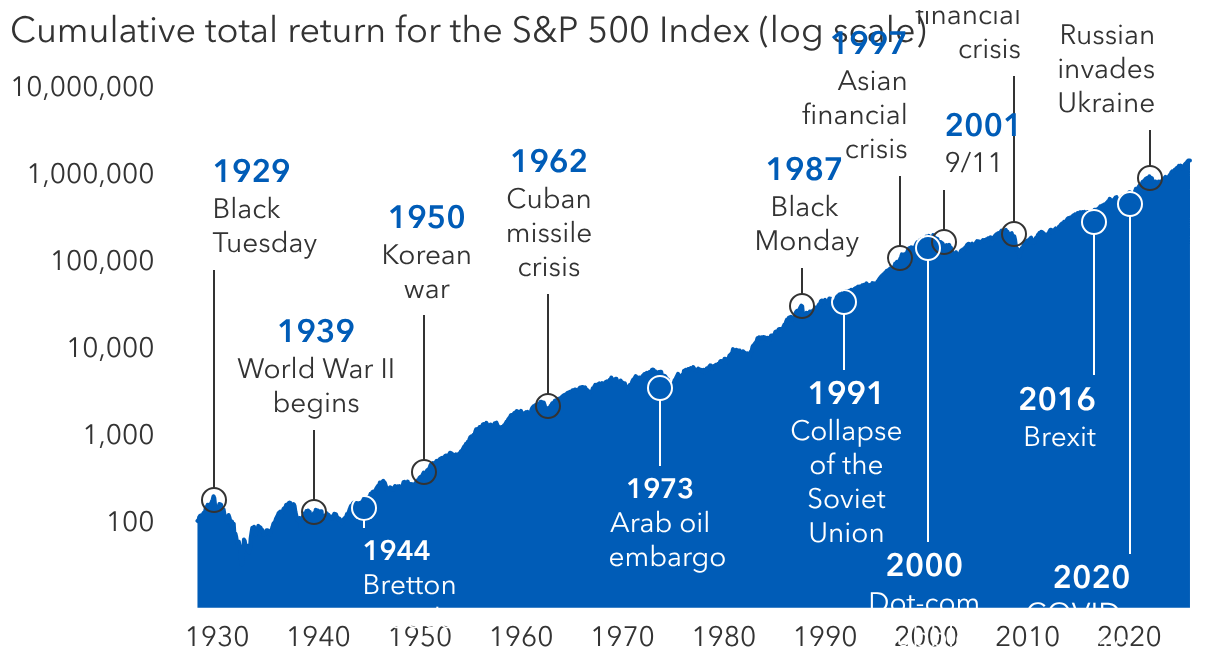
The US stock market has shown remarkable resilience through wars, financial crises and pandemics. “The incredible thing about the way the stock market works is as long as you've got companies doing amazing things, enabling them to grow and create new products, it's a flywheel,” says Lovelace. “It's a geometric process, not an arithmetic process, in terms of the benefits to investors.”

Markets have powered through many crises

Past results are not a guarantee of future results.

Sources: Capital Group, S&P Global, RIMES. As of 31 May 2026. Data is indexed to 100 as of 1 January 1928, based on cumulative total returns for the S&P 500 Index. Shown on a logarithmic scale. Past results are not predictive of results in future periods.

Lovelace notes that when he started his career, a 7% average annualised return was considered reasonable, with much of that driven by inflation. As inflation declined, many investors expected the total return on the market also would come down.


Instead, the opposite happened. “If you look at the long-term numbers now, even with the bear market in 2022, the compounding of the US stock market since the 1970s is north of 9%.” The lesson: Despite periods of upheaval throughout America’s history, long-term compounding has rewarded investors.

Jared Franz is an economist with 20 years of investment industry experience (as of 12/31/2025). He holds a PhD in economics from the University of Illinois at Chicago and a bachelor’s degree in mathematics from Northwestern University.

Jessica Spaly is an equity portfolio manager at Capital Group. She also serves on the Target Date Solutions Committee. She has 27 years of investment industry experience (as of 12/31/2025). She holds an MBA and a bachelor’s degree in economics from Harvard.

David Hoag is a fixed income portfolio manager with 38 years of investment industry experience (as of 12/31/2025). He holds an MBA from the University of Chicago and a bachelor's degree from Wheaton College.

Paul Benjamin is an equity portfolio manager with 20 years of investment industry experience (as of 12/31/2025). He holds an MBA from Stanford and a bachelor’s degree in finance and religion from Northwestern College.

Rob Lovelace is an equity portfolio manager and chair of Capital International, Inc. He has 40 years of investment industry experience (as of 12/31/2025). He holds a bachelor’s degree in mineral economics from Princeton. He also holds the Chartered Financial Analyst® designation.

Past results are not predictive of results in future periods. It is not possible to invest directly in an index, which is unmanaged. The value of investments and income from them can go down as well as up and you may lose some or all of your initial investment. This information is not intended to provide investment, tax or other advice, or to be a solicitation to buy or sell any securities.
 
Statements attributed to an individual represent the opinions of that individual as of the date published and do not necessarily reflect the opinions of Capital Group or its affiliates. All information is as at the date indicated unless otherwise stated. Some information may have been obtained from third parties, and as such the reliability of that information is not guaranteed.
 
Capital Group manages equity assets through three investment groups. These groups make investment and proxy voting decisions independently. Fixed income investment professionals provide fixed income research and investment management across the Capital organisation; however, for securities with equity characteristics, they act solely on behalf of one of the three equity investment groups.